Can You Get a Mortgage on a Barndominium?
Yes, you can finance a barndominium through several loan types including construction-to-permanent loans, USDA loans (for rural areas with 0% down), FHA loans (3.5% down), VA loans (0% down for veterans), and conventional mortgages with 10-25% down. The key challenge is finding lenders experienced with non-traditional construction, as not all banks will finance barndominium builds.
Barndominium financing is one of the most common questions we hear from buyers who are excited about the cost savings of barndominium construction but uncertain about how to pay for it. The good news is that every major loan program used for traditional home construction is also available for barndominiums -- construction-to-permanent loans, government-backed options like USDA, FHA, and VA, and conventional bank mortgages.
The challenge is not the existence of loan programs. The challenge is finding a lender who understands barndominiums and is willing to underwrite a loan for non-traditional construction. Not every bank has experience with steel-frame residential buildings, and some lenders automatically decline any application that does not fit their standard single-family home template. For a full overview of what barndominiums are and why steel construction is gaining popularity, see our complete guide to barndominiums.
This guide walks you through every financing option available in 2026, explains what lenders require, shows you exactly how to find barndominium-friendly lenders, and breaks down how financing decisions affect your total project cost. Whether you are a first-time buyer with limited savings or a veteran with access to VA benefits, there is a viable path to financing your barndominium build.
What Types of Loans Are Available for Barndominiums?
Barndominiums can be financed through six primary loan types: construction-to-permanent loans, USDA rural development loans, FHA construction loans, VA construction loans, conventional mortgages, and portfolio loans from local banks or credit unions. Each loan type has different down payment requirements, eligibility criteria, and terms.
Choosing the right loan program depends on your financial situation, the property location, your military service status, and how much cash you have available for a down payment. Here is a side-by-side comparison of every barndominium financing option available in 2026:
| Loan Type | Down Payment | Credit Score | Best For |
|---|---|---|---|
| Construction-to-Permanent | 10 - 20% | 680+ | Most barndo builders; single close, converts to mortgage |
| USDA Construction | 0% | 640+ | Rural properties; income-qualified buyers |
| FHA Construction | 3.5% | 580+ | First-time buyers; lower credit scores |
| VA Construction | 0% | 620+ (lender set) | Veterans and active-duty military |
| Conventional Mortgage | 10 - 25% | 700+ | Strong credit; completed or near-complete barndos |
| Portfolio / Credit Union | 15 - 25% | Varies | Non-standard situations; flexible underwriting |
| Personal Loan | None | 660+ | Small projects or gap financing; higher rates |
| Home Equity Loan/HELOC | None (uses equity) | 680+ | Owners with equity in existing property |
The first four options on this list are designed for new construction and are the most common paths for building a barndominium from scratch. Conventional mortgages work best when you are purchasing an already-built barndominium or refinancing after construction. Portfolio loans and credit unions are valuable fallback options when traditional lenders decline your application.
Personal loans and home equity products are secondary options that can fill gaps in funding but generally carry higher interest rates or shorter repayment terms. They are most useful for covering site preparation, down payment assistance, or finishing costs that exceed your construction loan budget.
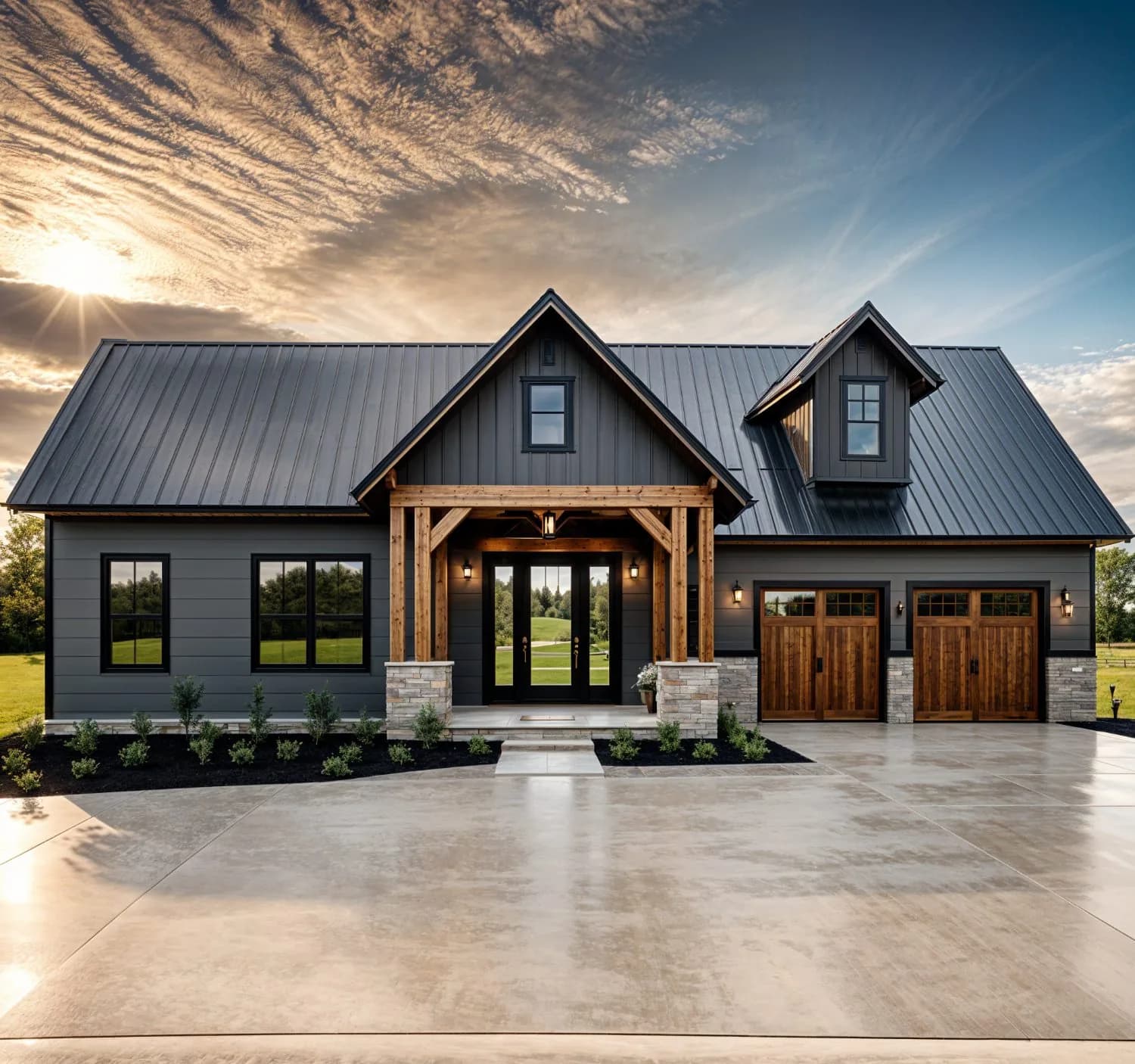
Barns & Barndos Insight: When applying for any barndominium loan, having professionally engineered plans and a licensed builder on the project dramatically improves your chances of approval. Lenders see engineered plans stamped by a licensed professional as a sign of a legitimate, code-compliant project. Every Barns & Barndos build includes structural engineering by professionals licensed in all 48 states, which satisfies this requirement for every lender we have worked with.
How Does a Construction-to-Permanent Loan Work for Barndominiums?
A construction-to-permanent loan finances your barndominium in two phases: a construction phase (typically 12-18 months) where you make interest-only payments on funds drawn, followed by automatic conversion to a standard 15- or 30-year mortgage once the build is complete. This single-close structure means you pay closing costs only once.
Construction-to-permanent (C2P) loans are the most popular financing option for barndominiums because they solve two problems at once: funding the build and providing long-term financing. Without a C2P loan, you would need a separate short-term construction loan and then a separate mortgage after completion -- meaning two applications, two closings, two sets of closing costs, and the risk that mortgage rates change between the two events.
Phase 1: The Construction Period
During the construction phase, the lender disburses funds to your builder in a series of draws that correspond to construction milestones. A typical draw schedule for a barndominium looks like this:
- Draw 1 -- Foundation (15-20% of loan): Released after the concrete slab is poured and cured, and the foundation passes inspection
- Draw 2 -- Steel erection (20-25%): Released after the steel frame, wall panels, and roof panels are installed
- Draw 3 -- Rough-in (20-25%): Released after plumbing, electrical, HVAC ductwork, and insulation are installed and pass inspection
- Draw 4 -- Interior finishing (20-25%): Released after drywall, flooring, cabinetry, and fixtures are installed
- Draw 5 -- Completion (10-15%): Released after the final inspection, punch list completion, and certificate of occupancy is issued
During this phase, you only pay interest on the funds that have been disbursed -- not the full loan amount. If your total loan is $300,000 and only $75,000 has been drawn for the foundation, your monthly payment is based on that $75,000 balance. At a 8% construction rate, that is roughly $500 per month in interest-only payments during the early stages.
Phase 2: Conversion to Permanent Mortgage
Once construction is complete and you receive your certificate of occupancy, the loan automatically converts to a permanent mortgage. The construction balance becomes your mortgage principal, and you begin making regular principal-and-interest payments on a fixed or adjustable rate over 15 or 30 years. There is no second closing, no additional appraisal, and no re-qualification required.
The permanent rate is typically locked at closing or during the construction phase, depending on your lender. Some lenders offer a float-down option, which allows you to lock a lower rate if market rates drop during construction. As of early 2026, permanent mortgage rates on C2P loans are generally running 6.5-8.0%, though this fluctuates with broader market conditions.
Construction-to-Permanent Loan Requirements
- Credit score of 680 or higher (some lenders require 700+)
- Down payment of 10-20% of total project cost (land + construction)
- Detailed construction plans stamped by a licensed engineer or architect
- Signed builder contract with a licensed, insured general contractor
- Itemized cost breakdown showing every line item of the project
- Proof of builder's license, insurance, and references
- Debt-to-income ratio below 43% (some lenders allow up to 50%)
- Land must be owned or included in the loan
Construction-to-Permanent Loan Summary
- Construction phase: 12-18 months, interest-only payments on drawn funds
- Permanent phase: 15- or 30-year fixed or adjustable rate mortgage
- Single closing: One application, one set of closing costs
- Down payment: 10-20% of total project cost
- Rate lock: Available at closing or during construction (varies by lender)
- Draw schedule: Funds released in 4-6 milestone-based disbursements
Can You Use a USDA Loan for a Barndominium?
Yes, USDA Rural Development loans can be used to finance a barndominium in eligible rural areas with 0% down payment required. The property must be your primary residence, located in a USDA-eligible area, and meet standard construction and habitability requirements. Household income must fall below 115% of the area median income.
USDA loans are one of the best-kept secrets in barndominium financing because they offer zero down payment on a property type that is overwhelmingly built in rural areas -- exactly where USDA loans are designed to be used. The alignment between where people want to build barndominiums and where USDA loans are available makes this program an excellent fit.
USDA Eligibility Requirements
- Location: The property must be in a USDA-eligible rural area. Contrary to popular belief, this does not mean you need to be on a farm. Many small towns, suburban fringes, and communities with populations under 35,000 qualify. You can check eligibility on the USDA property eligibility map.
- Income limits: Your household income must not exceed 115% of the area median income. For a family of four, this ranges from approximately $91,000 to $150,000+ depending on the county. All household income is counted, not just the borrower's.
- Primary residence: The barndominium must be your primary home. USDA loans cannot be used for second homes, vacation properties, or investment properties.
- Credit score: A minimum of 640 is required for automatic underwriting approval. Scores below 640 require manual underwriting, which adds time and uncertainty.
- Construction standards: The completed barndominium must meet HUD minimum property requirements for safety and habitability. This includes proper foundation, functional plumbing and electrical, adequate heating, and structural soundness.
USDA Construction Loan Process
The USDA offers a single-close construction loan that works similarly to a conventional construction-to-permanent loan. The lender finances the construction phase and then converts it to a permanent USDA-guaranteed mortgage. The key differences are the 0% down payment, a guarantee fee of 1% upfront (can be rolled into the loan) and 0.35% annually, and income verification that includes all household members.
Finding a lender who offers USDA construction loans for barndominiums can take some effort. Not all USDA-approved lenders do construction lending, and among those that do, not all are comfortable with non-traditional construction. Start with Farm Credit System lenders and community banks in rural markets -- they are the most likely to offer this product.
Barns & Barndos Insight: Because barndominiums are typically built on acreage in rural areas, USDA eligibility overlaps heavily with where our customers build. We recommend that every buyer check USDA eligibility early in the planning process -- qualifying for 0% down can free up tens of thousands of dollars for higher-quality finishes or site improvements. Our builds meet all HUD minimum property requirements, which satisfies the construction standards that USDA loans require.
Are FHA and VA Loans Available for Barndominiums?
Yes, both FHA and VA construction loans can be used for barndominiums. FHA loans require as little as 3.5% down with a 580 credit score and are available to any qualified buyer. VA construction loans offer 0% down and are available exclusively to veterans, active-duty service members, and eligible surviving spouses. Both programs require the barndominium to meet minimum property standards.
FHA Construction Loans for Barndominiums
FHA one-time-close construction loans allow you to finance the land, construction, and permanent mortgage in a single loan. The Federal Housing Administration insures the loan, which allows lenders to offer lower down payments and accept lower credit scores than conventional programs.
Key FHA construction loan details for barndominiums:
- Down payment: 3.5% with a 580+ credit score, or 10% with a 500-579 credit score
- Mortgage insurance: Required for the life of the loan (1.75% upfront + 0.55% annually on a 30-year term)
- Loan limits: Vary by county; check the FHA loan limit lookup tool for your area (2026 limits range from $524,225 to $1,209,750 in high-cost areas)
- Property requirements: The completed barndominium must pass an FHA appraisal and meet HUD minimum property standards for health, safety, and structural soundness
- Primary residence only: The property must be your main home
- Builder approval: Your builder must be approved by the FHA lender and carry required licenses and insurance
The biggest advantage of FHA financing is accessibility. If you have a lower credit score or limited savings, FHA construction loans open a door that conventional lending may not. The trade-off is the mortgage insurance premium, which adds to your monthly payment for the entire loan term.
VA Construction Loans for Barndominiums
VA construction loans are the single best financing option available for eligible borrowers. With 0% down payment, no mortgage insurance, and competitive interest rates, VA loans dramatically reduce the upfront cost of building a barndominium.
- Down payment: 0% -- no down payment required
- Mortgage insurance: None -- VA loans do not require PMI
- Funding fee: 1.25-3.3% of the loan amount (can be rolled into the loan; waived for veterans with service-connected disabilities)
- Eligibility: Veterans with qualifying service, active-duty service members, National Guard and Reserve members with qualifying service, and eligible surviving spouses
- Property requirements: The barndominium must meet VA minimum property requirements, which are similar to FHA standards
- Lender availability: Fewer lenders offer VA construction loans compared to VA purchase loans, so you may need to search more broadly
The challenge with VA construction loans is finding a lender. Many VA-approved lenders only handle purchase and refinance transactions, not construction. Regional banks, credit unions, and specialized construction lenders are your best bet. Veterans United, Navy Federal Credit Union, and USAA are known to offer VA construction loan products, though availability and terms change frequently.
| Feature | FHA Construction | VA Construction |
|---|---|---|
| Down Payment | 3.5% minimum | 0% |
| Mortgage Insurance | Required (MIP) | None |
| Eligibility | Any qualified buyer | Veterans/military only |
| Credit Score | 580+ (3.5% down) | 620+ (lender set) |
| Loan Limits | County-based FHA limits | No limit (with full entitlement) |
| Primary Residence | Required | Required |
| Lender Availability | Moderate | Limited for construction |
What Do Lenders Look for in a Barndominium Loan Application?
Lenders evaluating a barndominium loan application focus on six key areas: your credit score (typically 680+ for construction loans), down payment (10-25% for most programs), the appraisal and comparable sales, your builder's qualifications, professionally engineered construction plans, and your debt-to-income ratio (generally under 43%).
Understanding what lenders want before you apply saves time, prevents rejections, and positions you for the best possible terms. Barndominium loan applications receive more scrutiny than standard home purchases because the property type is less familiar to many underwriters. Here is what you need to have dialed in:
1. Credit Score and Credit History
Your credit score is the first filter. For conventional construction-to-permanent loans, most lenders want to see 680 or higher. Government-backed programs are more flexible (580 for FHA, 640 for USDA), but a higher score always means better rates. Beyond the score itself, lenders examine your credit history for late payments, collections, bankruptcies, and foreclosures. Clean credit history for the past 24 months is strongly preferred.
2. Down Payment and Cash Reserves
Most construction lenders want 10-20% down on the total project cost, which includes land and construction. For a $350,000 total project, that means $35,000-$70,000 in cash. Additionally, many lenders want to see 3-6 months of cash reserves (enough money to cover mortgage payments if your income is interrupted) after the down payment. If you own your land outright, the appraised value of the land typically counts toward your equity, reducing the cash needed at closing.
3. Appraisal and Comparable Sales
The lender will order an appraisal of the completed barndominium based on your plans and specifications. This is called a “subject-to-completion” appraisal. The appraiser estimates the market value of your barndominium as if it were already built, then compares it to recent sales of similar properties in the area. If the appraised value comes in below your loan amount, you will need to either increase your down payment, reduce the project scope, or find a new lender.
4. Builder Qualifications
Lenders take your builder's credentials seriously because they are lending money against a building that does not exist yet. They want to see:
- A valid general contractor license in your state
- General liability insurance and workers' compensation coverage
- Experience building barndominiums or steel-frame residential structures
- References from completed projects
- A signed construction contract with a detailed scope of work
- Financial stability (some lenders run credit checks on the builder)
5. Construction Plans and Engineering
You need detailed construction drawings stamped by a licensed engineer or architect. Generic plans downloaded from the internet will not satisfy most lenders. The plans must show the foundation design, structural steel layout, floor plan, elevations, mechanical systems, and compliance with local building codes. This is one area where working with a turnkey builder like Barns & Barndos pays dividends -- our engineering team produces lender-ready plans as part of every project.
6. Debt-to-Income Ratio
Your debt-to-income (DTI) ratio is your total monthly debt payments divided by your gross monthly income. Most construction lenders want this at or below 43%, though some allow up to 50% with compensating factors like a high credit score or large cash reserves. When calculating DTI, the lender uses your projected mortgage payment (not the construction-phase interest-only payment), so know what your permanent monthly payment will be before you apply.
Why Is It Harder to Finance a Barndominium Than a Traditional Home?
Barndominium financing is harder than traditional home financing for three main reasons: fewer comparable sales make appraisals difficult, many lenders are unfamiliar with steel-frame residential construction, and the secondary mortgage market (Fannie Mae and Freddie Mac) has historically been slower to standardize guidelines for non-traditional construction types.
Understanding why barndominium financing is more challenging helps you prepare for and overcome these obstacles. None of these issues are insurmountable, but they explain why you cannot simply walk into any bank and get a barndominium mortgage the way you would for a standard tract home.
The Comparable Sales Problem
Appraisers determine property value by comparing your property to recent sales of similar properties nearby. For traditional homes, there are usually dozens of comparable sales within a few miles. For barndominiums, there may be very few -- or none -- in your immediate area. When appraisers cannot find good comparables, they either discount the value, use comparables from farther away (which is less accurate), or decline the assignment entirely.
This is improving as more barndominiums are built and sold, particularly in Texas, Oklahoma, Tennessee, Florida, and other states where barndominiums are popular. But in areas where the concept is newer, comparable sales data remains thin. Building with proper permits and getting the property listed in the county tax records as a residential dwelling helps future appraisals in your area.
Lender Unfamiliarity
Many loan officers and underwriters have never processed a barndominium loan. They may not understand that a steel-frame barndominium is a permanent residential structure, not a temporary agricultural building. This unfamiliarity can lead to misclassification, additional documentation requests, or outright denial. Working with a lender who has closed barndominium loans before eliminates this friction.
Secondary Market Standards
When banks make mortgage loans, they often sell those loans to Fannie Mae or Freddie Mac on the secondary market. These agencies have specific guidelines about what types of properties qualify. While barndominiums on permanent foundations generally qualify, the classification process can create uncertainty for lenders. Portfolio lenders (who keep loans on their own books) avoid this issue entirely, which is why they are often more willing to finance barndominiums.
How to Overcome Financing Challenges
- Build to code with full permits -- this is the single most important thing you can do for financing, appraisal, and resale
- Use professionally engineered plans -- stamped engineering eliminates lender concerns about structural integrity
- Work with an experienced builder -- lenders trust licensed builders with documented barndominium experience
- Target barndominium-friendly lenders -- do not waste time with lenders who have never closed a barndo loan
- Provide excellent documentation -- detailed plans, cost breakdowns, and builder qualifications reduce underwriter uncertainty
How Do You Find Lenders Who Finance Barndominiums?
The best sources for barndominium financing are local credit unions, Farm Credit System lenders, community banks with construction loan departments, portfolio lenders, and mortgage brokers who specialize in construction lending. Large national banks are generally the least likely to finance barndominiums due to rigid underwriting guidelines.
Finding the right lender is often the most time-consuming part of the barndominium financing process. Many buyers waste weeks or months applying to banks that will never approve a barndominium loan. Here is a targeted strategy for finding a lender quickly:
1. Start with Credit Unions
Local and regional credit unions are frequently the most barndominium-friendly lenders. Because they are member-owned cooperatives rather than publicly traded banks, they have more flexibility in their lending criteria. Many credit unions in rural areas have been financing barndominiums and metal buildings for years and understand the property type well. Call the credit unions in your county and neighboring counties and ask specifically: “Do you offer construction loans for barndominiums or metal building homes?”
2. Contact Farm Credit System Lenders
The Farm Credit System is a nationwide network of borrower-owned lending institutions that specialize in rural and agricultural lending. Farm Credit lenders like Texas Farm Credit, AgSouth Farm Credit, and Farm Credit of Florida are experienced with rural construction and non-traditional building types. They offer competitive rates and are often willing to finance barndominiums that national banks will not touch.
3. Community Banks with Construction Lending
Community banks (typically those with fewer than 10 branches in a local market) are another strong option. These banks often portfolio their construction loans, meaning they keep the loans on their own books rather than selling them to the secondary market. This gives them the flexibility to approve projects that do not fit neatly into Fannie Mae or Freddie Mac guidelines. Ask for the construction lending department specifically -- the general mortgage department may not know what the construction team can approve.
4. Work with a Construction Lending Mortgage Broker
A mortgage broker who specializes in construction lending has relationships with multiple lenders and knows which ones finance barndominiums in your area. A good broker can save you weeks of phone calls by matching your situation to the right lender immediately. Make sure the broker has actual experience with barndominium and metal building financing, not just standard residential construction.
5. Ask Your Builder
Experienced barndominium builders maintain relationships with lenders who finance their projects. Your builder should be able to recommend two or three lenders who have successfully closed loans on their previous builds. This is one of the underrated advantages of working with an established builder -- they have already solved the lender-finding problem.
Barns & Barndos Insight: Our team regularly connects customers with lenders who finance barndominium construction. Because we provide complete engineering packages, detailed cost breakdowns, and carry full licensing and insurance, lenders are confident in the projects we deliver. If you are struggling to find financing, reach out to us through our quote request page -- we can point you toward lenders who have financed Barns & Barndos builds in your state.
How Does Barndominium Financing Affect Your Total Build Cost?
Financing adds 50-80% to the base construction cost of a barndominium over the life of a 30-year loan. On a $250,000 build financed at 7% for 30 years, you will pay approximately $349,000 in total interest, making the true cost of the home roughly $599,000. Your down payment size, interest rate, and loan term determine how much financing adds to your project.
Many barndominium buyers focus intensely on the construction budget (rightfully so -- see our complete barndominium guide for those details) but give less thought to how their financing decisions affect the total lifetime cost of the project. The interest you pay over 30 years can easily exceed the original construction cost.
Interest Costs by Loan Amount
Here is what financing costs look like across different barndominium project sizes, assuming a 30-year fixed rate mortgage:
| Loan Amount | Rate | Monthly Payment | Total Interest (30 yr) | Total Cost |
|---|---|---|---|---|
| $150,000 | 7.0% | $998 | $209,263 | $359,263 |
| $200,000 | 7.0% | $1,331 | $279,017 | $479,017 |
| $250,000 | 7.0% | $1,663 | $348,772 | $598,772 |
| $350,000 | 7.0% | $2,329 | $488,281 | $838,281 |
| $500,000 | 7.0% | $3,327 | $697,544 | $1,197,544 |
How Your Down Payment Affects Total Cost
A larger down payment reduces both your loan amount and your total interest paid. On a $300,000 barndominium project, here is how different down payment levels compare:
| Down Payment | Cash Needed | Loan Amount | Total Interest (30 yr @ 7%) |
|---|---|---|---|
| 0% (USDA/VA) | $0 | $300,000 | $418,527 |
| 3.5% (FHA) | $10,500 | $289,500 | $403,879 |
| 10% | $30,000 | $270,000 | $376,674 |
| 20% | $60,000 | $240,000 | $334,822 |
| 25% | $75,000 | $225,000 | $313,895 |
The difference between 0% down and 20% down on a $300,000 project is roughly $83,700 in total interest savings over 30 years. However, the 0% down options (USDA and VA) allow you to preserve your cash for other priorities like landscaping, furnishing, or building up an emergency fund. There is no universally “right” answer -- the best down payment depends on your cash reserves, your qualifying loan type, and your comfort level with debt.
Strategies to Reduce Financing Costs
- Choose a 15-year term if affordable: A 15-year mortgage at 6.5% on $250,000 costs $146,000 in total interest -- less than half the interest on a 30-year term
- Make extra principal payments: Adding even $200/month to your payment can shave 5-8 years off a 30-year mortgage
- Build smaller and smarter: Every $10,000 reduction in construction cost saves approximately $14,000 in interest over 30 years at 7%
- Refinance when rates drop: If you lock in at 8% during construction and rates drop to 6% in two years, refinancing could save $40,000-$100,000+ in lifetime interest
- Use land equity as down payment: If you already own your building site, the land value counts toward your equity position, reducing or eliminating the cash needed at closing
The most important financial decision in any barndominium project is not the flooring selection or the countertop upgrade -- it is the financing structure. A 1% difference in interest rate on a $300,000 loan over 30 years equals roughly $64,000 in total cost difference. Spending a few extra weeks finding the right lender with the best rate is worth far more than any construction savings you can negotiate.
What Documents Do You Need for a Barndominium Loan?
A barndominium loan application requires personal financial documents (tax returns, bank statements, pay stubs), property documents (land deed or purchase contract, survey), and construction documents (engineered plans, builder contract, itemized cost breakdown, proof of builder insurance). Having these documents organized before applying accelerates approval and signals to the lender that you are a serious, prepared borrower.
Barndominium loan applications require more documentation than a standard home purchase because the lender needs to verify both your financial qualifications and the construction project details. Here is a complete checklist organized by category:
Personal Financial Documents
- Two years of federal tax returns (all pages and schedules)
- Two most recent pay stubs (or year-to-date income statement if self-employed)
- Two months of bank statements for all accounts
- Two months of investment/retirement account statements (if using for reserves)
- W-2 forms for the past two years
- If self-employed: profit-and-loss statement and business tax returns
- Photo ID (driver's license or passport)
- Social Security number for credit check authorization
Property and Land Documents
- Deed to the land (if already owned) or land purchase contract (if buying)
- Land survey or plat showing property boundaries and building site
- Proof of clear title and title insurance commitment
- Flood zone determination (FEMA flood map check)
- Well and septic permits (if applicable)
- Zoning verification or land use approval from the county
Construction Documents
- Complete construction plans stamped by a licensed engineer or architect (foundation, structural steel, floor plan, elevations, mechanical systems)
- Signed construction contract between you and your builder
- Itemized cost breakdown (line-by-line budget covering every aspect of the project from foundation to final landscaping)
- Construction timeline with milestones and expected completion date
- Builder's license and state registration
- Builder's general liability insurance certificate
- Builder's workers' compensation insurance certificate
- Builder references and portfolio of completed projects
- Building permit (or permit application if not yet issued)
Insurance Documents
- Builder's risk insurance quote or binder (required during construction; typically 1-5% of project value)
- Homeowner's insurance quote for the completed structure (required before closing for the permanent loan phase). For details on barndominium insurance requirements and costs, see our guide to barndominium insurance.
Barns & Barndos Insight: When you work with Barns & Barndos, the construction documentation package is built into the process. Our team provides the stamped engineering plans, detailed cost breakdown, construction timeline, licensing documentation, and insurance certificates that lenders require. Customers who bring a complete Barns & Barndos project package to their lender consistently report faster approvals and fewer back-and-forth documentation requests. Ready to get started? Request a free budgetary estimate and we will help you assemble everything your lender needs.
Important: Barns & Barndos does not build builder-grade or low-end structures. We design and build premium steel homes engineered to last a lifetime and keep your family safe. Every project features custom design, professional-grade materials, and finishes that reflect the quality of a tailored home -- not a commodity product.
Key Takeaways: Barndominium Financing in 2026
- Multiple loan options exist -- construction-to-permanent, USDA (0% down), FHA (3.5% down), VA (0% down), conventional, and portfolio loans all work for barndominiums
- Finding the right lender is the biggest challenge -- focus on credit unions, Farm Credit lenders, and community banks rather than large national banks
- Professional engineering and a licensed builder are the two most important factors in loan approval beyond your personal financial qualifications
- Down payments range from 0-25% depending on your loan program and lender
- Financing adds 50-80% to your base construction cost over a 30-year term -- your interest rate and loan term matter more than most construction line items
- Prepare your documents before applying -- organized borrowers get faster approvals, better rates, and fewer headaches
- USDA loans are underutilized -- if your property is in a rural area, check eligibility first for the chance at 0% down financing