What Makes Barndominium Interiors Unique?
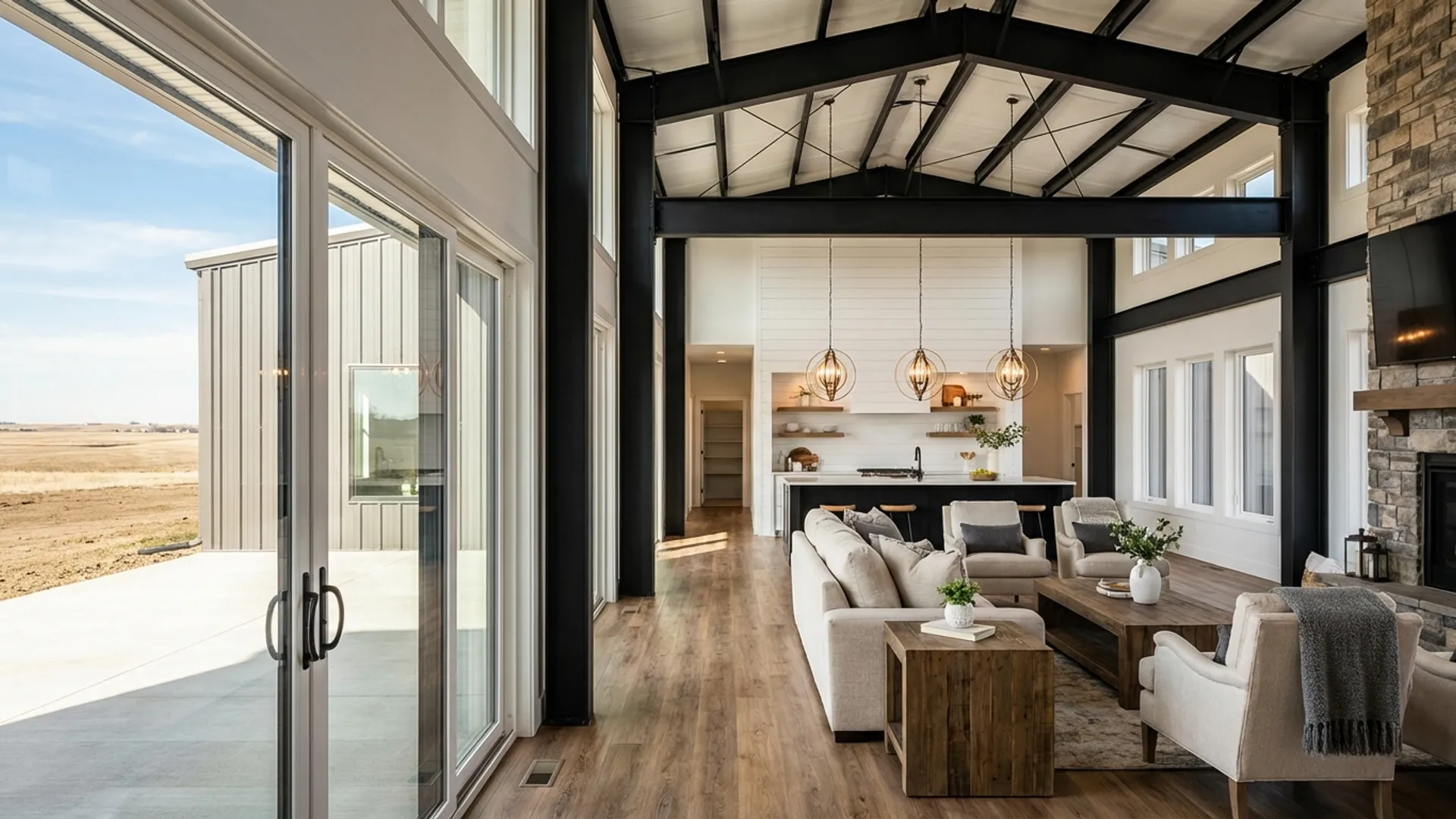
Barndominium interiors are defined by high ceilings (often 14-16 feet on the ground floor), open-concept layouts with no load-bearing interior walls, exposed structural elements like steel beams, and an abundance of natural light -- features that create a distinctive modern-industrial aesthetic that traditional stick-built homes cannot replicate.
If you have never been inside a well-designed barndominium, the experience is striking. You walk through the front door and the space opens up in ways that conventional homes simply cannot achieve. There are no columns breaking up the sightlines, no cramped hallways forced by structural necessity, and no eight-foot ceilings pressing down on you. The interior feels more like a high-end loft or a custom architectural home than a converted barn.
For a comprehensive overview of what a barndominium is and why steel construction is transforming residential building, see our complete guide to barndominiums. This article focuses specifically on interior design: how to transform the raw potential of a steel structure into a beautiful, functional living space that reflects your personal style.
The structural advantages of steel clear-span construction give barndominium owners design freedom that traditional homebuilders envy. Here is what makes the interior of a barndominium fundamentally different:
- No load-bearing interior walls: Every wall inside a barndominium is a partition wall. Move it, remove it, or skip it entirely -- the building stands regardless. This means your floor plan is limited only by your imagination, not by structural requirements.
- Soaring ceiling heights: Standard barndominium ground-floor ceilings reach 14-16 feet at the peak, compared to the 8-9 foot ceilings in most traditional homes. In a two-story barndominium, the ground floor typically has 10-12 foot ceilings with 9-10 feet on the second floor.
- Clear spans of 40-80+ feet: Steel framing can span 60, 80, or even 100+ feet without a single interior support column. This creates uninterrupted living spaces that feel grand without requiring grand-home square footage.
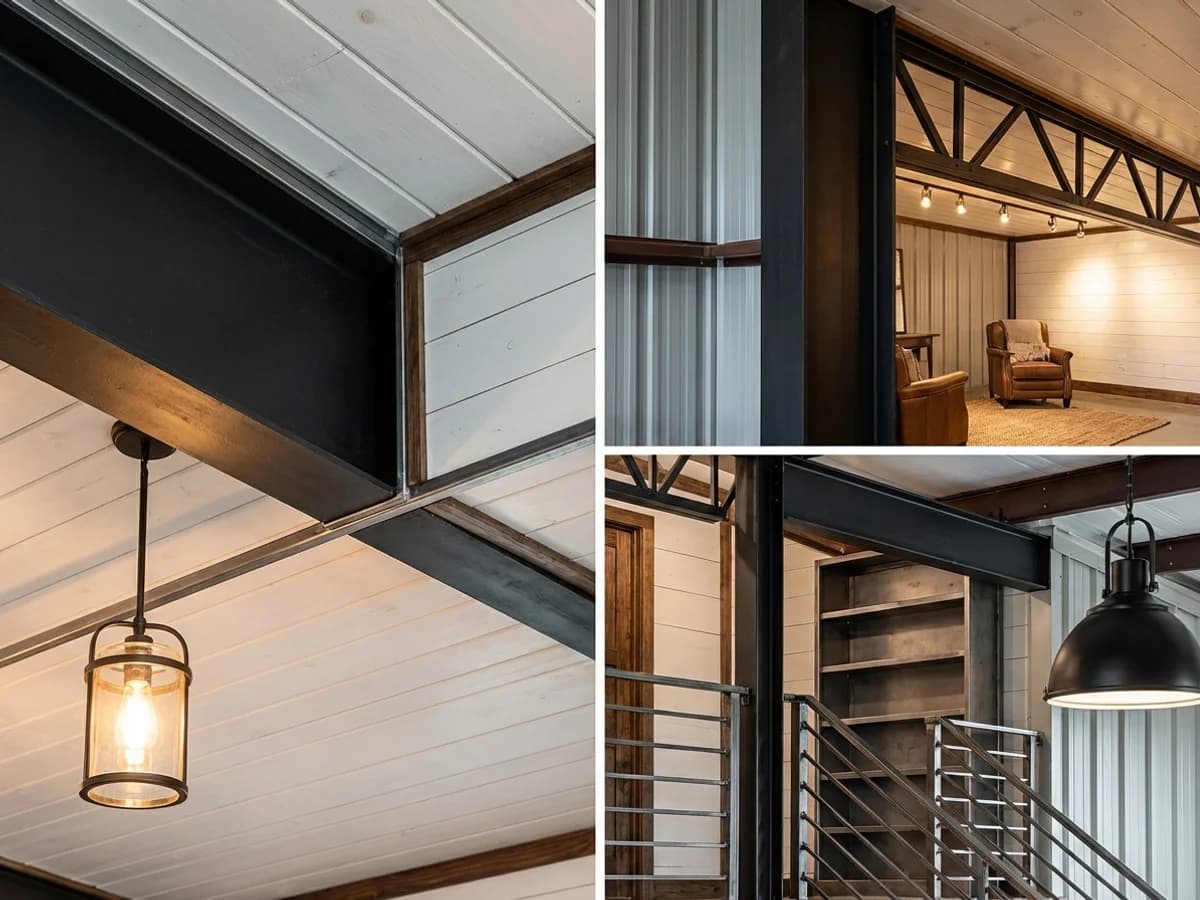
- Exposed structural elements: Steel beams, columns, and trusses can be left exposed as design features rather than hidden behind drywall. This gives barndominiums their signature industrial-chic character.
- Flexible lighting: High ceilings and open spans allow for dramatic lighting designs -- large pendant fixtures, clerestory windows, skylights, and layered lighting schemes that would be impossible in a standard-height home.
Key Takeaways: What Makes Barndominium Interiors Special
- 14-16 foot ceilings on the ground floor create a sense of volume and openness unmatched by traditional homes
- Zero load-bearing interior walls means total floor plan flexibility -- change the layout without structural consequences
- Clear spans of 40-80+ feet deliver wide-open living areas with no columns or support walls interrupting the space
- Exposed steel beams serve as architectural features that define the modern barndominium aesthetic
What Are the Most Popular Barndominium Interior Design Styles?
The most popular barndominium interior design styles are modern farmhouse, industrial modern, rustic, contemporary minimalist, and Texas ranch. Modern farmhouse is the dominant style, blending shiplap accents, neutral palettes, and clean lines with the open architecture of steel construction.
One of the biggest misconceptions about barndominiums is that they all look the same inside -- metal walls, concrete floors, and a shop-like feel. In reality, a barndominium interior can match any design style you want. The steel shell is simply the canvas. What you do with the interior finishing determines the final look and feel.
| Design Style | Key Elements | Best For | Cost Impact |
|---|---|---|---|
| Modern Farmhouse | Shiplap accents, painted cabinets, subway tile, neutral palette with black hardware, open shelving | Families, resale appeal | Moderate |
| Industrial Modern | Exposed beams, polished concrete floors, metal accents, Edison lighting, raw material finishes | Urban-minded owners, loft feel | Lower (uses existing structure) |
| Rustic / Lodge | Reclaimed wood, stone accents, timber-wrapped beams, leather furnishings, earth tone palette | Rural properties, ranch settings | Higher (natural materials) |
| Contemporary | Clean lines, flat-panel cabinets, large format tile, monochromatic palette, floor-to-ceiling windows | Design-forward owners | Moderate to high |
| Minimalist | White walls, concealed storage, simple fixtures, open floor plan with few partitions, natural light focus | Small footprint builds | Lower (fewer finishes) |
| Texas Ranch | Wide plank wood floors, stone fireplace, iron fixtures, leather and hide accents, oversized kitchen island | Large acreage properties | Higher (premium materials) |
Modern Farmhouse: The Most Popular Choice
Modern farmhouse dominates barndominium interior design because the style is a natural fit for the architecture. The combination of a steel structure with warm, approachable interior finishes creates a home that feels both contemporary and inviting. Key elements include white or light gray walls, shiplap accent walls behind the main living area or master bed, painted cabinets with matte black or brushed brass hardware, open shelving in the kitchen, and a mix of wood and metal textures throughout. This style works at every budget level and has strong resale appeal.
Industrial Modern: Embracing the Structure
Industrial modern design leans into what makes a barndominium different rather than trying to hide it. Exposed steel beams become a centerpiece. Polished concrete floors replace traditional flooring. Metal light fixtures, raw edge wood countertops, and glass-and-steel room dividers reinforce the aesthetic. This style can actually be more affordable because you are using the building's existing structural elements as design features instead of covering them up. It is especially effective in barndominiums with attached shops where the living space transitions from the workshop area.
Rustic and Texas Ranch: Traditional Character
Rustic and Texas ranch styles layer warmth and character onto the barndominium frame using natural materials. Reclaimed wood accent walls, stone veneer on fireplace surrounds and kitchen islands, wrought iron light fixtures, and wide plank hardwood or hand-scraped flooring create a space that feels established and grounded. These styles tend to cost more because natural stone, reclaimed wood, and custom ironwork carry premium price tags, but the results are stunning -- especially on large properties where the interior scale matches the surrounding landscape.
Barns & Barndos Insight: You do not have to commit to a single design style throughout your entire barndominium. Many of our most successful builds blend styles -- for example, a modern farmhouse kitchen flowing into an industrial-style great room with exposed beams, then transitioning to a warm, rustic master suite. The open floor plan of a barndominium actually makes style transitions feel natural because you can use flooring changes, ceiling treatments, and lighting zones to define each area.
How Do You Design an Open-Concept Barndominium Living Area?
Designing an open-concept barndominium living area requires intentional zone definition using furniture groupings, flooring transitions, lighting layers, and ceiling treatments to create distinct functional areas within the larger open space. Without these visual anchors, a wide-open barndominium interior can feel cavernous rather than comfortable.
The biggest challenge in barndominium interior design is not creating openness -- the steel structure gives you that automatically. The challenge is making a 40-foot-wide, 16-foot-tall open space feel like a home rather than a warehouse. The solution is strategic zone definition: creating distinct living areas within the open plan without using walls.
Furniture Placement and Groupings
In a barndominium great room, furniture does the work that walls do in a traditional home. A large sectional sofa defines the living area. A dining table and chairs anchor the dining zone. A kitchen island creates a natural boundary between cooking and living spaces. The key is to float furniture away from walls rather than pushing everything to the perimeter. A sofa placed perpendicular to the wall creates a visual room divider while maintaining the open sightlines that make barndominiums feel so spacious.
For homes with clear spans of 40-60 feet, consider using area rugs sized at 8x10 or 9x12 feet to anchor each furniture grouping. The rug visually defines the zone even when the flooring is continuous throughout the space.
Flooring Transitions
Changing flooring materials is one of the most effective ways to define zones in an open-concept barndominium. A common approach is polished concrete or tile in the kitchen and entry areas (durable, easy to clean) transitioning to luxury vinyl plank or hardwood in the living and dining zones (warmer, softer underfoot). The transition can be a clean straight line using a metal transition strip, or a more organic pattern where one material flows into the other.
Lighting Layers
With 14-16 foot ceilings, lighting design becomes critical. A single overhead fixture cannot adequately light a barndominium great room. Instead, design in layers:
- Ambient lighting: Recessed LED cans on dimmers across the full ceiling provide overall illumination. Plan for one recessed light per 20-25 square feet of floor area.
- Task lighting: Pendant lights over the kitchen island (36 inches above the counter surface is standard), under-cabinet lights in the kitchen, and reading lamps at seating areas.
- Accent lighting: LED strip lights along exposed beams, wall sconces at art locations, and uplighting on architectural features. Accent lighting is what transforms a barndominium from well-lit to dramatic.
- Statement fixtures: A large chandelier or pendant cluster in the great room serves as both a light source and a visual anchor that brings the 16-foot ceiling down to human scale.
Ceiling Treatments as Zone Markers
Varying the ceiling treatment from one zone to another creates visual separation without walls. For example, the kitchen area might have a smooth painted ceiling at 10 feet (created with a dropped soffit), while the adjacent living area soars to the full 16-foot vaulted ceiling. This height change naturally signals a transition between spaces. Wood planking on the ceiling above the dining area can further distinguish it from the living zone, even though no wall separates them.
Barns & Barndos Insight: One of the most common design mistakes in open-concept barndominiums is making everything the same height and material. Monotony kills the drama of a big open space. Use ceiling height changes, different flooring materials, and varied lighting to create rhythm and variety. Our design team works with every client to plan these transitions before construction begins -- it is much easier (and cheaper) to build in ceiling soffits and flooring transitions during construction than to add them later.
What Flooring Works Best in a Barndominium?
The best barndominium flooring options are polished concrete ($3-$8 per square foot), luxury vinyl plank ($3-$7 per square foot), porcelain tile ($5-$15 per square foot), and engineered hardwood ($6-$12 per square foot). Polished concrete is the most popular choice because it is durable, low-maintenance, and complements the industrial aesthetic of steel construction.
Flooring is one of the most impactful interior design decisions in a barndominium because it covers every square foot of living space. The right flooring sets the tone for the entire interior. The wrong choice can undermine even the best furniture and fixtures. Here is a detailed comparison of the most popular options:
| Flooring Type | Cost Per SF | Durability | Maintenance | Best Use |
|---|---|---|---|---|
| Polished Concrete | $3 - $8 | Excellent (50+ years) | Very low | Great rooms, kitchens, entryways, industrial style |
| Stained Concrete | $4 - $10 | Excellent | Low (reseal every 2-3 years) | Living areas, artistic or rustic styles |
| Luxury Vinyl Plank (LVP) | $3 - $7 | Good (15-25 years) | Very low | Bedrooms, living areas, budget-friendly whole-house |
| Porcelain Tile | $5 - $15 | Excellent (lifetime) | Low | Bathrooms, kitchens, entryways, contemporary style |
| Engineered Hardwood | $6 - $12 | Good (20-30 years) | Moderate (refinish every 7-10 years) | Living rooms, bedrooms, farmhouse and rustic styles |
| Solid Hardwood | $8 - $15 | Excellent (can refinish multiple times) | Moderate to high | Living rooms, dining areas, luxury builds |
| Epoxy Coating | $4 - $10 | Excellent | Very low | Garages, shop areas, utility rooms |
Polished Concrete: The Barndominium Favorite
Polished concrete is the most popular barndominium flooring choice for good reason. Your barndominium already has a concrete slab foundation -- polishing and sealing it transforms the structural floor into the finished floor, eliminating the cost of a separate flooring material entirely. At $3-$8 per square foot for grinding, polishing, and sealing, it is one of the most affordable finished flooring options. The result is a sleek, modern surface that complements both industrial and contemporary design styles, resists scratches and stains, and never needs refinishing.
The main drawback of polished concrete is comfort. It is hard and cold underfoot, which makes it less ideal for bedrooms and areas where you stand for long periods. Many barndominium owners use polished concrete in the main living areas, kitchen, and entryways, then switch to a warmer flooring material in bedrooms and bathrooms.
Luxury Vinyl Plank: The Versatile All-Rounder
Luxury vinyl plank (LVP) has become the go-to flooring for barndominiums where owners want the look of hardwood without the cost or maintenance. Modern LVP is virtually indistinguishable from real wood, comes in hundreds of colors and textures, is waterproof, scratch-resistant, and comfortable underfoot. At $3-$7 per square foot installed, it delivers exceptional value. LVP works in every room including bathrooms and kitchens, making it a practical choice for whole-house installation. Barns & Barndos includes LVP flooring as the standard option in our Standard finish tier.
Hardwood and Tile: Premium Choices
Engineered hardwood and porcelain tile are the premium flooring choices for barndominium owners who want a traditional residential look. Engineered hardwood is preferred over solid hardwood in barndominiums because it handles the slight moisture and temperature fluctuations of a steel building better than solid wood. Large-format porcelain tile (12x24 or 24x24 inch) creates a clean, contemporary look that works particularly well in kitchens and bathrooms. Both options are available in the Barns & Barndos High End and Luxury finish tiers.
Key Takeaways: Barndominium Flooring
- Polished concrete ($3-$8/SF) is the most cost-effective option since you are finishing the existing slab rather than adding a new material
- LVP ($3-$7/SF) offers the best balance of appearance, durability, and comfort for whole-house installation
- Mix materials by zone -- use durable, easy-clean options in kitchens and entries, warmer options in bedrooms
- Budget impact: Flooring for a 2,000 SF barndominium ranges from $6,000 (polished concrete) to $30,000 (solid hardwood throughout)
How Do You Handle Exposed Steel Beams in Interior Design?
Exposed steel beams in a barndominium can be painted to match the ceiling for a subtle look, painted a contrasting color (matte black is the most popular) for a dramatic statement, wrapped in reclaimed wood for a rustic aesthetic, or accented with LED strip lighting to highlight the structural geometry of the space.
The steel beams in a barndominium are the architectural feature that most clearly distinguishes it from a traditional home. How you treat these beams sets the design direction for the entire interior. There are four main approaches:
Paint to Contrast (Most Popular)
Painting exposed steel beams a bold contrasting color is the most popular treatment in modern barndominium design. Matte black is the dominant choice because it creates strong visual lines against white or light-colored ceilings, works with virtually every design style, and highlights the industrial character of the structure. Dark charcoal and deep bronze are also effective alternatives. The key is using a flat or matte finish rather than glossy, which can look cheap under residential lighting.
Paint to Blend
If you want a more traditional interior where the steel structure recedes into the background, paint the beams the same color as the ceiling. White beams against a white ceiling virtually disappear, creating a clean, conventional look. The beams are still subtly visible -- you can see the shape and dimension -- but they no longer dominate the room. This approach works well in contemporary and minimalist design styles.
Wood Wrapping
Wrapping steel beams in wood creates the appearance of timber framing while maintaining the structural advantages of steel. Reclaimed barnwood wrapping is the most popular option for rustic and farmhouse styles, typically costing $15-$30 per linear foot installed. Cedar or pine wrapping is more affordable at $8-$20 per linear foot. The wood is attached to a framework around the steel beam, creating a box that completely conceals the steel. This treatment is particularly effective when combined with a wood-planked ceiling.
Accent Lighting
LED strip lighting along exposed beams transforms the structure into a dramatic design element. Warm white LED strips (2700-3000K color temperature) tucked along the top edge of beams create an indirect uplight that washes the ceiling with a soft glow. This technique works whether the beams are painted, natural steel, or wood-wrapped. The cost is modest -- $3-$8 per linear foot for quality LED strips and installation -- but the visual impact is significant, especially in the evening.
Barns & Barndos Insight: Before deciding how to treat your beams, consider the ceiling height. In spaces with 14-16 foot ceilings, exposed beams painted dark create beautiful visual anchors that bring the scale down to a comfortable level. In spaces with lower ceilings (9-10 feet, like a second floor), painting beams to match the ceiling color avoids making the space feel compressed. Our design team helps every client make this decision based on their specific floor plan and ceiling heights.
What Are the Best Barndominium Kitchen Designs?
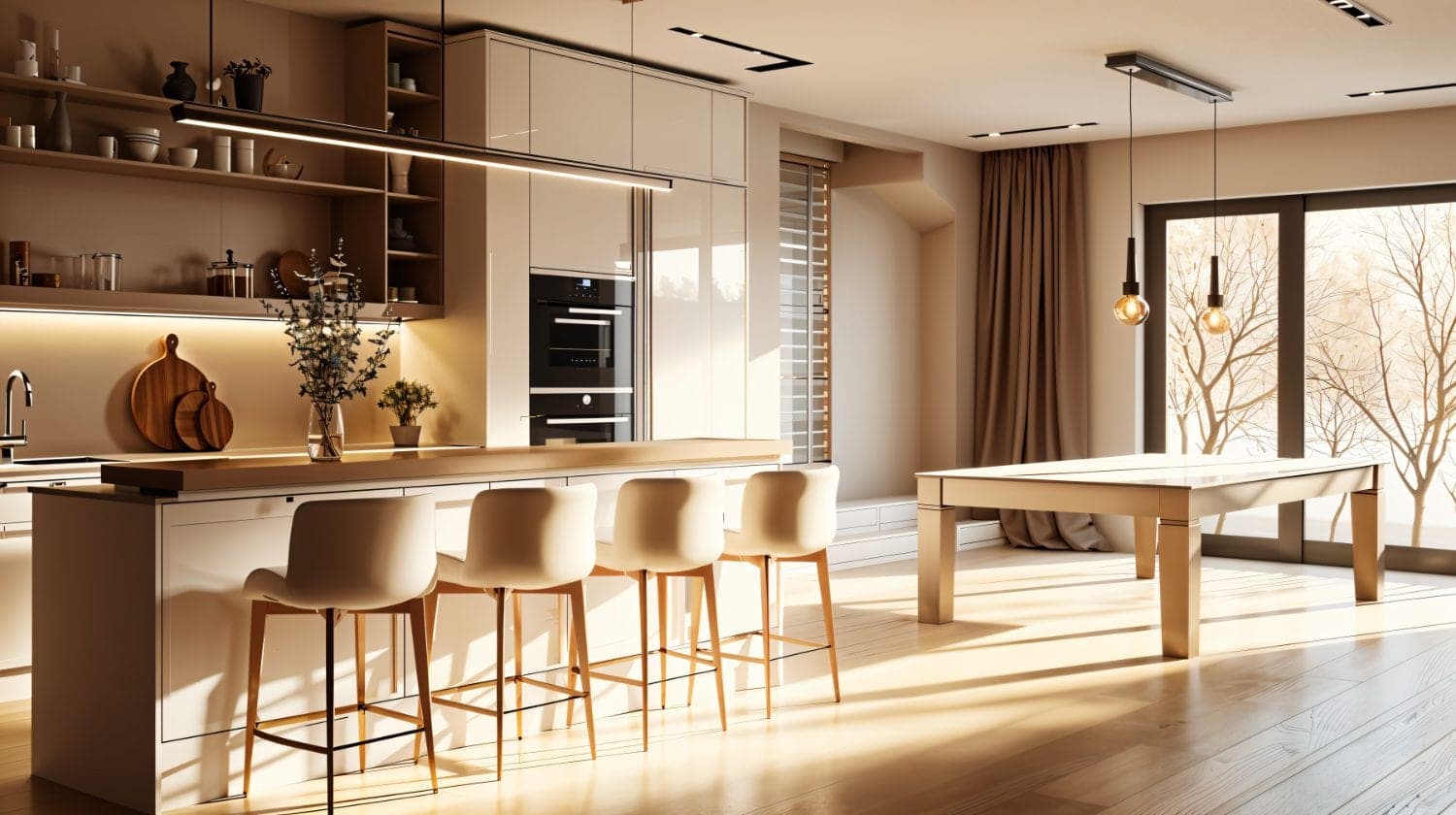
The best barndominium kitchen designs take advantage of the open floor plan with large center islands (8-12 feet long), open sightlines to the living area, tall upper cabinets that utilize the higher ceiling height, and a mix of open shelving and closed storage. The kitchen island serves as the primary gathering point and the visual boundary between cooking and living zones.
The kitchen is the most important room in a barndominium -- both for daily livability and for resale value. In an open-concept barndominium, the kitchen is always visible from the main living area, which means every design decision is on display. This is where your finish selections have the most visual impact, and it is where the difference between finish tiers is most apparent.
Island Layouts: The Center of Barndominium Living
Nearly every barndominium kitchen includes a center island, and for good reason. In an open floor plan with no walls separating the kitchen from the living area, the island serves multiple functions: food prep workspace, casual dining bar, visual room divider, and social hub. Standard barndominium islands are 8-10 feet long and 4 feet wide, with seating on the living-room side and storage on the kitchen side. Larger builds can accommodate 12-foot or even 14-foot islands that become the dominant feature of the entire great room.
Waterfall countertops -- where the countertop material cascades down the sides of the island -- have become a defining feature of high-end barndominium kitchens. This treatment works equally well with quartz, granite, or concrete countertop materials.
Cabinetry Styles
Barndominium kitchen cabinetry follows the overall design style of the home. Shaker-style painted cabinets in white, gray, or navy are the most popular for modern farmhouse designs. Flat-panel cabinets in matte finishes suit contemporary and minimalist styles. Stained wood cabinets in walnut, hickory, or rustic alder complement rustic and Texas ranch aesthetics. All three Barns & Barndos finish tiers include custom cabinetry -- the difference between tiers is the door style, material quality, and hardware selection.
Countertop Selections
Countertops are one of the highest-impact finish selections in a barndominium kitchen. The most popular options include:
- Quartz ($50-$120/SF installed): The most popular choice overall. Non-porous, low-maintenance, consistent color and pattern, available in hundreds of styles including convincing marble looks.
- Granite ($40-$100/SF installed): Natural stone with unique veining and character. Requires periodic sealing but offers unmatched depth and visual interest.
- Butcher block ($40-$80/SF installed): Warm, natural, and perfect for farmhouse and rustic kitchens. Requires more maintenance but develops beautiful patina over time.
- Concrete ($65-$135/SF installed): Matches the industrial aesthetic of a barndominium. Each slab is custom-cast with unique coloring and edge profiles. Requires sealing.
Open Shelving vs. Closed Storage
The open-shelving trend works particularly well in barndominium kitchens because the high ceilings give you vertical space that closed upper cabinets cannot fully utilize. A popular approach is to use closed upper cabinets on one wall for practical storage and open shelving on an adjacent wall for display items -- dishes, cookbooks, plants, and decorative pieces. This combination delivers both function and visual interest without making the kitchen feel top-heavy.
How Do You Design Barndominium Bedrooms and Bathrooms?
Barndominium bedrooms benefit from the flexibility of non-load-bearing walls to create generously sized rooms with walk-in closets and ensuite bathrooms. Master suites can include vaulted ceilings, while loft bedrooms above the main living area maximize square footage. Barndominium bathrooms range from efficient guest baths to spa-inspired master retreats with walk-in showers, freestanding tubs, and dual vanities.
While the great room and kitchen get the most design attention, bedrooms and bathrooms are where you live your most private moments. These spaces deserve careful design, and the structural freedom of a barndominium gives you options that traditional homes cannot easily match.
Master Suite Design
The master suite in a barndominium can be as grand or as efficient as you choose. Because no walls are load-bearing, you can dedicate as much square footage as you want to the primary bedroom, walk-in closet, and ensuite bathroom. A popular configuration for ground- floor master suites is a 16x18 foot bedroom (288 SF), an 8x10 foot walk-in closet (80 SF), and a 10x12 foot bathroom (120 SF) -- totaling roughly 490 square feet for the complete suite.
For barndominium owners who value privacy, placing the master suite at the opposite end of the building from the guest bedrooms creates separation that is difficult to achieve in a compact traditional home. The long, open floor plan of a barndominium makes this layout natural.
Loft Bedrooms
In two-story barndominiums or builds with mezzanine levels, loft bedrooms are one of the most dramatic design features available. A loft overlooking the double-height great room below creates a sense of connection to the main living space while maintaining a separate sleeping zone. Standard loft bedrooms have 9-10 foot ceilings on the second level, which is comfortable for everyday use. Open railings made of steel cable, glass panels, or wrought iron maintain the visual openness between the loft and the space below.
Spa-Style Bathrooms
Barndominium bathrooms have evolved far beyond the basic functional spaces of early steel buildings. Today's barndominium master bathrooms rival those found in luxury custom homes. Popular design elements include:
- Walk-in showers with frameless glass enclosures, rain showerheads, and large-format porcelain tile (the open feel matches the barndominium aesthetic)
- Freestanding soaking tubs positioned as focal points, often near a window for natural light
- Dual vanities with undermount sinks, quartz or granite countertops, and framed mirrors that match the home's overall design style
- Heated tile floors -- radiant floor heating in the bathroom adds luxury at a relatively modest cost ($8-$15/SF) and eliminates the cold-floor problem that polished concrete creates in wet areas
- Barn-door style bathroom entries that reinforce the barndominium aesthetic while saving swing-space in tight layouts
Barns & Barndos Insight: When designing your bathroom layout, cluster all wet rooms together -- master bath, guest bath, laundry, and kitchen -- on the same side of the building or stacked vertically in a two-story plan. This reduces plumbing runs, lowers construction cost, and simplifies future maintenance. Our Standard tier at $250/SF includes quality bathroom finishes with solid surface countertops, tile showers, and modern fixtures. The High End ($275/SF) and Luxury ($300/SF) tiers upgrade to premium tile, freestanding tubs, frameless glass, and designer hardware.
How Do You Add Natural Light to a Barndominium?
The best ways to add natural light to a barndominium are large window walls on the south- and east-facing sides, clerestory windows near the roofline, ridge skylights, glass entry and patio doors, and interior transom windows above partition walls. Because barndominiums have no structural limitations on window placement in exterior walls, you can incorporate significantly more glazing than a traditional stick-built home.
Natural light transforms a barndominium interior. A steel building with small windows can feel dark and industrial. The same building with generous glazing feels open, airy, and connected to the outdoors. Since the exterior walls of a barndominium are non-structural skin panels attached to the steel frame, windows can be placed virtually anywhere and sized to any dimension without compromising structural integrity.
Window Placement Strategy
Maximize windows on the south and east walls to capture morning and midday sun. West-facing windows provide afternoon light but can cause overheating in warm climates -- use low-E glass or shading devices on west exposures. North-facing windows deliver consistent, diffused light that is ideal for workspaces and studios. For a standard 40x60 barndominium, a well-designed window plan includes 15-25 windows of varying sizes, concentrating larger windows in the main living areas and smaller windows in bedrooms and bathrooms.
Clerestory Windows
Clerestory windows -- narrow windows placed high on the wall near the roofline -- are one of the most effective lighting strategies in a barndominium. They flood the interior with natural light without sacrificing wall space at eye level for furniture, art, or cabinetry. Because barndominium walls are 14-16 feet tall, there is ample room for a row of clerestory windows at the 12-foot mark that lights the entire living space while maintaining privacy from the ground level.
Skylights and Ridge Lights
Skylights placed in the metal roof panels bring light directly into the center of the building where windows cannot reach. Tubular skylights (solar tubes) are a cost-effective option at $500-$1,500 each installed, channeling light from the roof to the interior through a reflective tube. Traditional rectangular skylights cost $1,500-$4,000 each but deliver more light and can include operable venting. Ridge skylights that run along the peak of the roof are a premium option that can transform the entire interior with a dramatic strip of daylight.
Glass Doors
Sliding glass doors, French doors, and folding glass wall systems serve as both entry points and massive light sources. A 12-foot sliding glass door in the main living area floods the space with light and creates an indoor-outdoor connection that is especially appealing for barndominiums on acreage properties. Multi-panel folding glass door systems (NanaWall-style) can open an entire wall of the barndominium to a covered patio, blurring the line between interior and exterior living space.
Key Takeaways: Natural Light in Barndominiums
- No structural window limitations -- barndominium walls are non- structural skin panels, so windows can go anywhere and be any size
- Clerestory windows at the 12-foot mark provide light without sacrificing wall space for furniture and storage
- Skylights ($500-$4,000 each) bring light to the center of the building where exterior windows cannot reach
- Glass doors provide the single biggest source of natural light while connecting interior and exterior living
What Interior Finishes Does Barns & Barndos Offer?
Barns & Barndos offers three turnkey finish packages: Standard at $250 per square foot, High End at $275 per square foot, and Luxury at $300 per square foot. All three tiers include custom cabinetry, quality flooring, countertops, fixtures, appliances, full HVAC, plumbing, electrical, insulation, and drywall -- the difference between tiers is the grade and style of the finish selections.
Every Barns & Barndos barndominium is a complete, turnkey home. You do not buy a shell kit and figure out the rest. You work with our design team to select your floor plan, choose your finish tier, and customize the details. Then we build the entire project -- steel structure, foundation, and complete interior finishing -- and hand you the keys to a move-in- ready home.
| Feature | Standard ($250/SF) | High End ($275/SF) | Luxury ($300/SF) |
|---|---|---|---|
| Flooring | Luxury vinyl plank | Hardwood or premium tile | Wide-plank hardwood or natural stone |
| Countertops | Solid surface | Quartz | Premium natural stone or designer quartz |
| Cabinetry | Painted shaker style | Custom-stained or two-tone | Custom millwork with premium hardware |
| Lighting | Standard fixture package | Upgraded designer fixtures | Premium designer and smart lighting |
| Bathroom | Tile shower, standard vanity | Upgraded tile, dual vanity | Freestanding tub, frameless glass, heated floors |
| Appliances | Quality standard brand | Upgraded stainless package | Premium brand (e.g., GE Profile, KitchenAid) |
| HVAC | Standard efficiency system | High-efficiency system | High-efficiency with zoned climate control |
| Exterior | PVDF-coated steel panels, 50-year warranty | PVDF-coated steel panels, 50-year warranty | PVDF-coated steel panels, 50-year warranty |
| Structure | Galvanized steel framing | Galvanized steel framing | Galvanized steel framing |
Notice that the structural quality is identical across all three tiers. Every Barns & Barndos build uses galvanized steel framing (not painted or bare steel), carries a 50-year PVDF warranty on all exterior finishes, and is engineered by licensed professionals in all 48 states. The only difference between tiers is the interior finish selections -- you choose the level of luxury that fits your budget and lifestyle. For the full details on every finish selection in each tier, visit our finish packages page.
Pricing Examples by Size
To give you a clear picture of what each tier costs for common barndominium sizes:
- 1,500 SF barndominium: Standard $375,000 | High End $412,500 | Luxury $450,000
- 2,000 SF barndominium: Standard $500,000 | High End $550,000 | Luxury $600,000
- 2,500 SF barndominium: Standard $625,000 | High End $687,500 | Luxury $750,000
- 3,000 SF barndominium: Standard $750,000 | High End $825,000 | Luxury $900,000
These are all-inclusive prices covering the complete project: steel structure, foundation, interior finishing, all mechanical systems, and the 50-year PVDF exterior warranty. There are no hidden costs or surprise allowances. The only items not included are land, site preparation, and utility connections -- which vary too much by location to include in a standard price. For a complete cost breakdown including those items, see our 2026 barndominium guide.
Barns & Barndos Insight: The most popular choice among our clients is the High End tier at $275 per square foot. It delivers a significant upgrade in kitchen countertops, flooring quality, and bathroom finishes compared to the Standard tier, while staying well below the Luxury price point. Many clients also customize across tiers -- for example, choosing Luxury-level kitchen finishes with Standard-level bedroom finishes to concentrate their budget where it matters most. Our design team works with you to find the right balance.
Important: Barns & Barndos does not build builder-grade or low-end structures. We design and build premium steel homes engineered to last a lifetime and keep your family safe. Every project features custom design, professional-grade materials, and finishes that reflect the quality of a tailored home -- not a commodity product.
Key Takeaways: Barndominium Interior Design
- 14-16 foot ceilings and clear spans create interior spaces that traditional homes cannot match -- use zone definition to make them feel like home
- Six popular design styles from modern farmhouse to industrial modern -- the steel shell is a blank canvas for any aesthetic
- Flooring makes the biggest visual impact -- polished concrete ($3-$8/SF) and LVP ($3-$7/SF) are the most popular choices
- Exposed steel beams are design features, not problems -- paint them, wrap them, or light them to define your style
- The kitchen island is the centerpiece of open-concept barndominium living, serving as workspace, dining bar, and room divider
- Natural light is unlimited because exterior walls are non-structural -- use clerestory windows, skylights, and glass doors generously
- Barns & Barndos finish tiers ($250, $275, $300 per SF) deliver turnkey interiors with custom cabinetry, quality materials, and the same galvanized steel structure and 50-year PVDF warranty across all levels