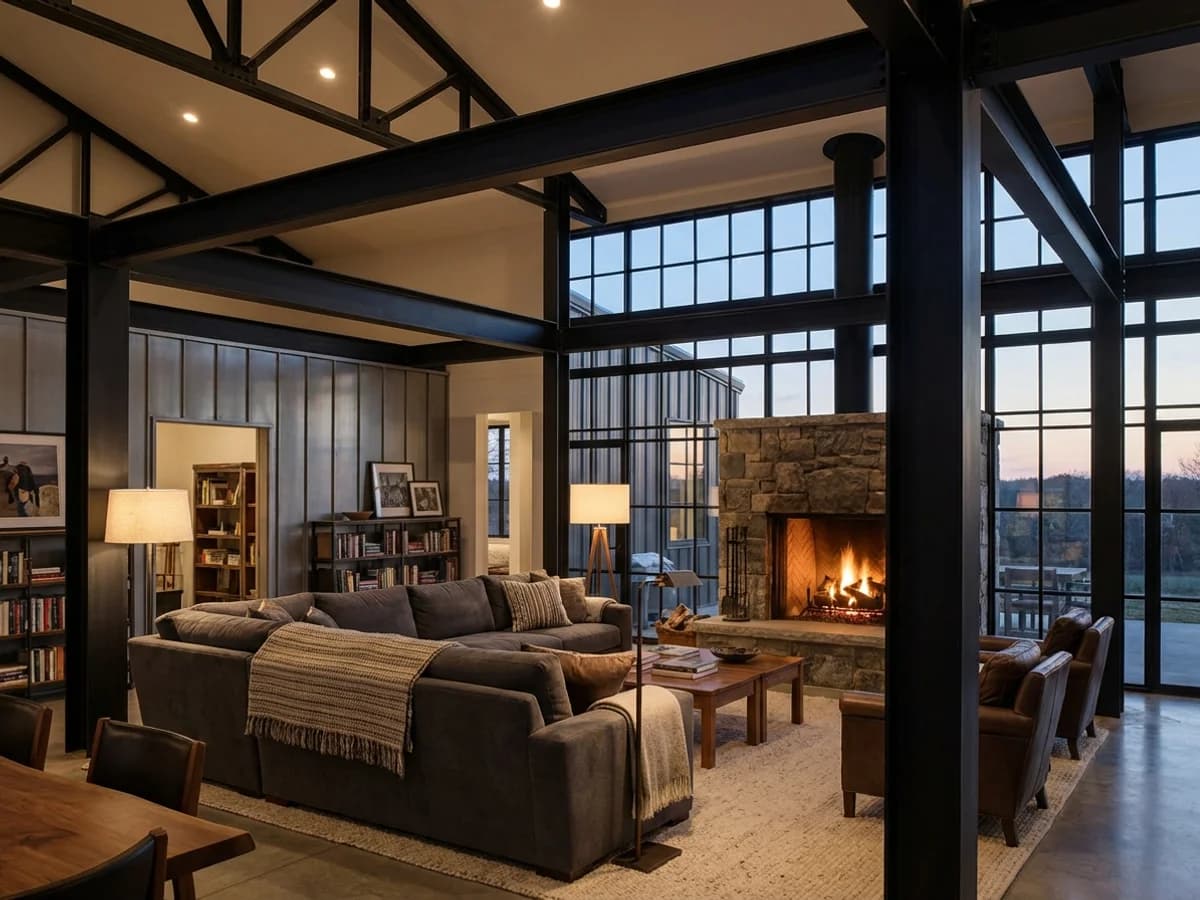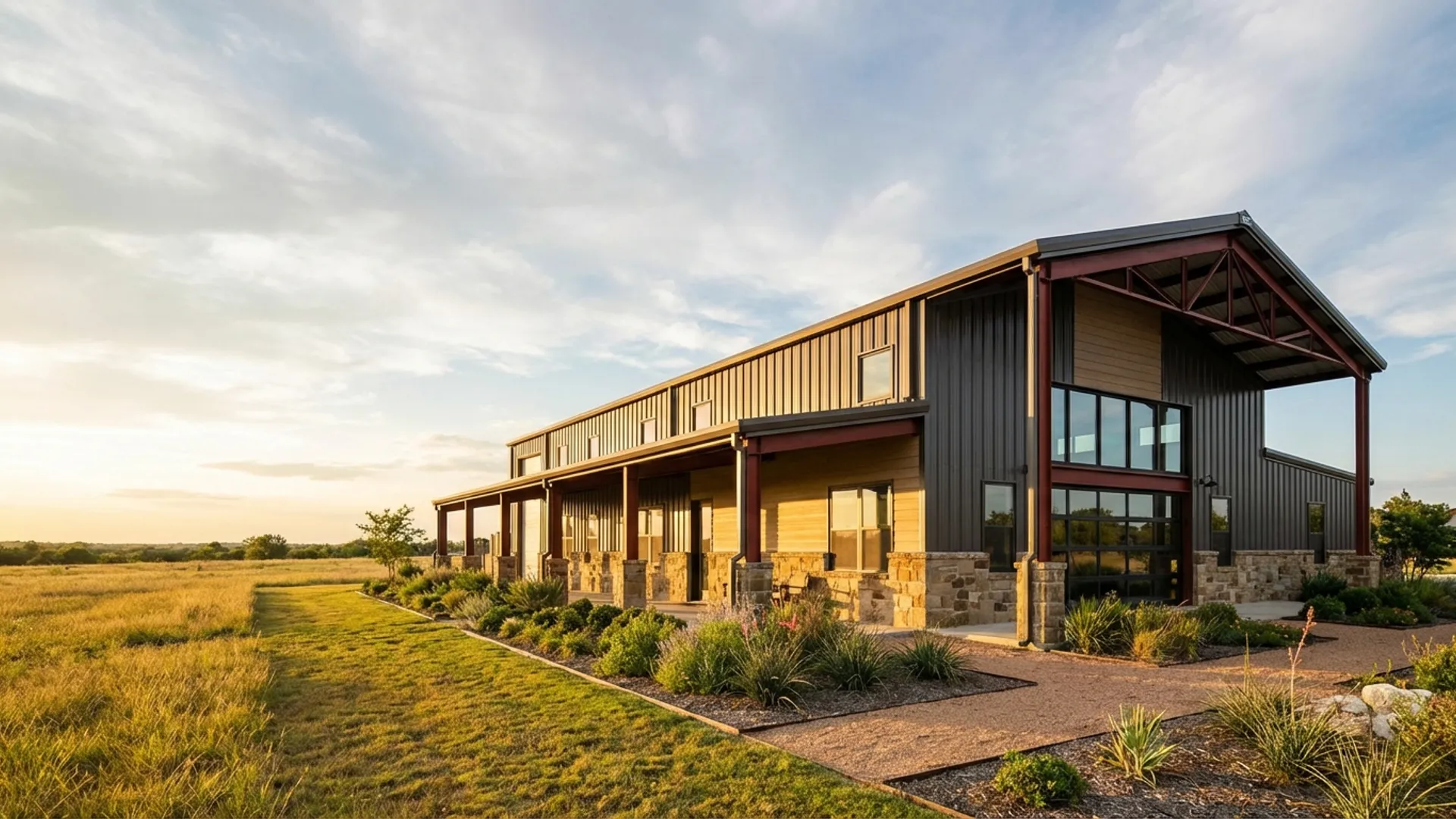
What Are the Biggest Advantages of a Barndominium?
The biggest advantages of a barndominium are lower construction costs (10-12% less than traditional homes), faster build timelines (5-8 months versus 8-14 months), exceptional durability from steel framing, wide-open floor plan flexibility with no load-bearing interior walls, and significantly lower long-term maintenance requirements.
Barndominiums have moved from a niche rural housing option to one of the fastest-growing segments in residential construction. The appeal is straightforward: you get more home for less money, built faster and with materials that last longer. For a full overview of what barndominiums are, how they are built, and why steel-framed residential construction is gaining mainstream acceptance, see our complete guide to barndominiums.
This guide is an honest assessment. We build barndominiums for a living at Barns & Barndos, so we know both the strengths and the limitations of this building type. Rather than cherry-picking only the positives, we are going to walk through every major advantage and every real disadvantage so you can make an informed decision about whether a barndominium is right for you.
Here is a high-level summary before we dig into the details:
| Category | Barndominium Advantage | Potential Drawback |
|---|---|---|
| Cost | 10-12% lower construction costs | Premium turnkey builds can approach traditional home pricing |
| Build Speed | 5-8 months vs. 8-14 months traditional | Finding experienced barndominium builders varies by region |
| Durability | Steel lasts 50-100+ years, resists rot and termites | Requires proper coatings to prevent corrosion |
| Floor Plans | Complete layout flexibility with no load-bearing walls | Open-span design can feel “cavernous” without thoughtful interior design |
| Maintenance | Minimal exterior maintenance for decades | Scratches or damage to coatings need prompt repair |
| Financing | Lower total loan amount needed | Fewer lenders offer barndominium-specific construction loans |
| Zoning | Widely accepted in rural and exurban areas | May face restrictions in subdivisions and urban zones |
| Resale | Growing market acceptance and buyer interest | Appraisal challenges in areas with few comparable sales |
| Energy Efficiency | Excellent with spray foam insulation | Steel conducts heat -- proper insulation is non-negotiable |
| Weather Resistance | Engineered for 130-150+ mph winds, non-combustible | Can be louder in rain without proper insulation |
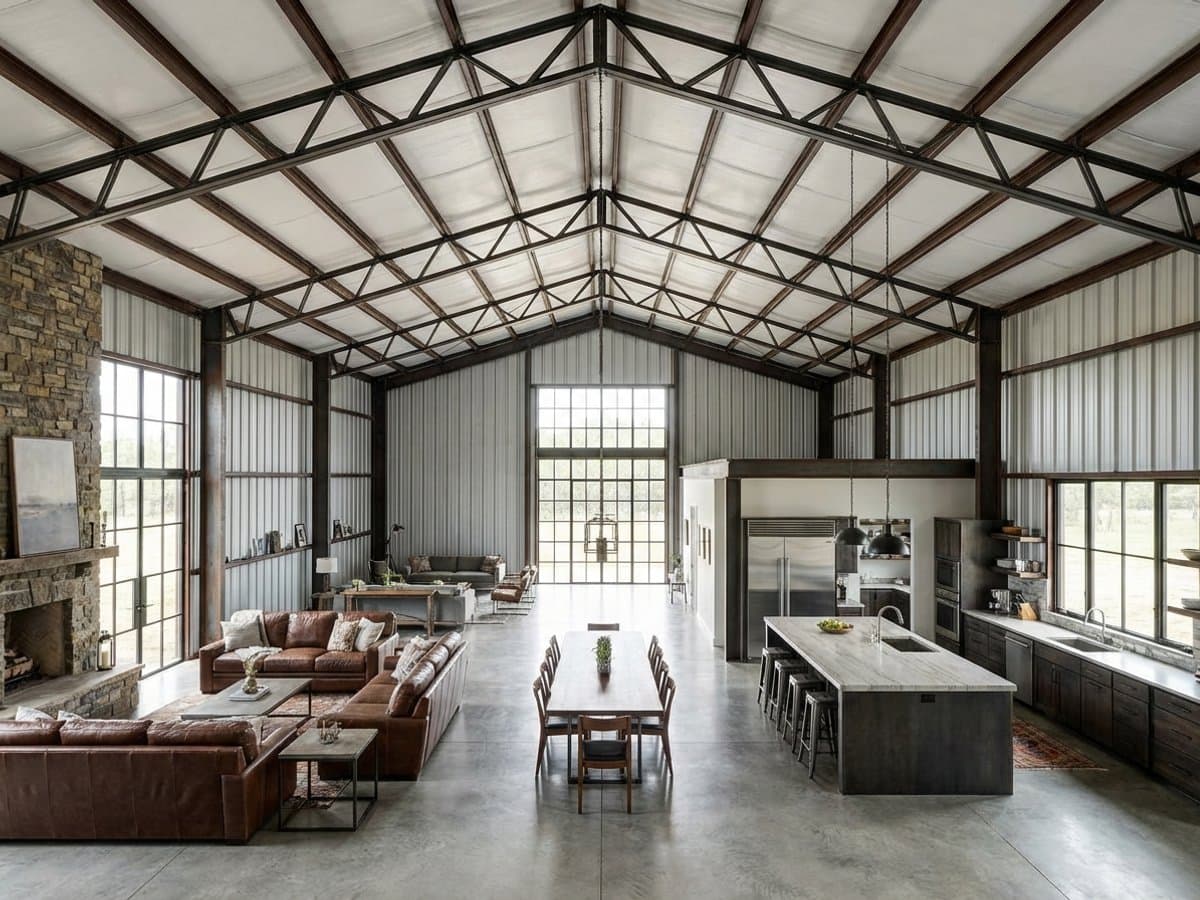
How Much Money Can You Save with a Barndominium?
A barndominium saves 10-12% on construction costs compared to a traditional stick-built home at the same finish level. On a 2,000 square foot home, that translates to $48,000 to $56,000 in savings depending on your region and the finishes you select.
The cost advantage of barndominium construction is not marketing spin -- it is a structural reality of how steel buildings go together. For a detailed cost breakdown with exact pricing by size and finish tier, see our complete barndominium guide.
The savings come from four primary sources:
- Faster construction reduces labor costs. Steel framing erects in 1-3 days versus 2-4 weeks for wood framing. Since labor is typically 35-45% of total construction cost, cutting framing time dramatically reduces the overall budget.
- Pre-engineered components reduce waste. Steel members arrive cut to spec from the factory. Wood framing generates 10-15% on-site waste that you pay for but never use.
- No load-bearing interior walls simplify construction. In a barndominium, interior walls are purely for layout. There are no headers, no point loads, and no structural engineering required for interior partitions. This means less material and faster interior framing.
- Lower long-term ownership costs. Steel does not rot, warp, attract termites, or need repainting. Over a 30-year ownership period, maintenance savings can total $30,000-$50,000 compared to a wood-framed home that needs periodic siding repair, painting, and pest treatment.
Real-World Cost Comparison
| Home Size | Barndominium (Mid-Range) | Traditional Stick-Built | Estimated Savings |
|---|---|---|---|
| 1,500 SF | $300,000 - $351,000 | $336,000 - $393,000 | $36,000 - $42,000 |
| 2,000 SF | $400,000 - $468,000 | $448,000 - $524,000 | $48,000 - $56,000 |
| 2,500 SF | $500,000 - $585,000 | $560,000 - $655,000 | $60,000 - $70,000 |
| 3,000 SF | $600,000 - $702,000 | $672,000 - $786,000 | $72,000 - $84,000 |
It is important to note that premium turnkey barndominium builds narrow this gap. Barns & Barndos offers three finish tiers -- Standard at $250 per square foot, High End at $275, and Luxury at $300 -- which are priced in the upper range of barndominium construction because they include galvanized steel framing, a 50-year PVDF warranty, and premium interior finishes. Even at these premium price points, you are getting a superior structural product compared to a traditional stick-built home at the same cost.
Barns & Barndos Insight: The biggest cost mistake we see is buyers comparing a bare-bones shell kit price to a finished traditional home price and concluding that barndominiums are “70% cheaper.” A fair comparison requires the same finish level on both sides. At equivalent finishes, the realistic savings are 10-12% -- still substantial, but not the inflated numbers you see on social media.
Are Barndominiums Faster to Build?
Yes, barndominiums are significantly faster to build than traditional homes. A turnkey barndominium typically takes 5 to 8 months from foundation pour to move-in, compared to 8 to 14 months for conventional stick-built construction, roughly 20-30% faster. The steel frame itself can be erected in as little as 1 to 3 days.
Speed is one of the most compelling advantages of barndominium construction, and it is not just about convenience. Faster construction translates directly into financial savings: fewer months of construction loan interest payments, fewer months paying rent while your home is being built, and less exposure to material price escalation.
Where the Time Savings Come From
The construction timeline advantage breaks down across several phases:
- Framing phase: A steel frame erects in 1-3 days versus 2-4 weeks for traditional wood framing. This is the single biggest time savings in the entire build.
- Weather delays: Steel framing is unaffected by moisture during erection. Wood framing can be delayed by rain and must be dried before enclosing, adding days or weeks to the schedule.
- Simpler exterior enclosure: Steel wall and roof panels go up quickly once the frame is standing, creating a weather-tight shell in days rather than weeks.
- Interior flexibility: Because there are no load-bearing interior walls, interior framing proceeds faster with no structural considerations.
The interior finishing phase -- plumbing, electrical, HVAC, drywall, flooring, cabinetry -- takes roughly the same amount of time regardless of whether the structure is steel or wood. This phase typically represents 60-70% of the total build timeline. The speed advantage of a barndominium is concentrated in the structural and enclosure phases.
Build Timeline Comparison
- Barndominium foundation to dry-in: 1-3 weeks
- Traditional home foundation to dry-in: 6-10 weeks
- Interior finishing (both types): 2-4 months
- Total barndominium timeline: 5-8 months
- Total traditional home timeline: 8-14 months
- Potential interest savings: $3,000-$10,000+ on construction loan
How Durable Are Barndominiums?
Barndominiums are exceptionally durable. Steel-framed barndominiums have a structural lifespan of 50 to 100+ years, resist termites, rot, mold, and warping, and can be engineered to withstand wind loads exceeding 150 mph. With proper coatings like PVDF paint systems, the exterior panels maintain their appearance for 50 years with virtually no maintenance.
Durability is arguably the strongest single advantage of barndominium construction. While cost savings get more attention, the longevity and low maintenance of steel-framed buildings deliver compounding value over decades of ownership. Our barndominium vs. traditional home comparison covers this topic in detail, but here is a focused look at what makes barndominiums so durable.
Steel vs. Wood: Durability by the Numbers
| Durability Factor | Steel Frame (Barndominium) | Wood Frame (Traditional) |
|---|---|---|
| Structural Lifespan | 50-100+ years | 30-50 years before major repair |
| Termite Resistance | Immune | Requires ongoing treatment |
| Rot Resistance | Immune | Vulnerable to moisture exposure |
| Fire Resistance | Non-combustible (steel melts at 2,500+F) | Combustible (ignites at 400-500F) |
| Wind Resistance | Engineered to 130-150+ mph | Standard code: 90-115 mph |
| Warping / Settling | Does not warp or twist | Can warp, bow, and settle over time |
| Exterior Maintenance | Minimal for 50+ years (PVDF coating) | Repaint every 7-15 years, siding replacement at 20-30 years |
The combination of pest immunity, rot resistance, fire resistance, and extreme weather performance makes steel-framed barndominiums one of the most durable residential building types available. This durability also has practical financial implications: lower barndominium insurance premiums in many cases, reduced maintenance budgets, and longer intervals between major repairs.
Barns & Barndos Insight: Every Barns & Barndos build uses galvanized steel framing and PVDF-coated exterior panels backed by a 50-year warranty. Galvanization adds a layer of zinc that prevents corrosion even at cut edges and fastener points -- the two areas where bare steel is most vulnerable. This is not an upgrade or an add-on; it is standard on every structure we build.
What Are the Disadvantages of a Barndominium?
The main disadvantages of a barndominium are more limited financing options compared to traditional homes, potential zoning and HOA restrictions in some areas, appraisal challenges in markets with few comparable sales, the requirement for high-quality insulation to manage thermal conductivity, and the need for experienced metal building contractors who may not be available in every region.
No building type is perfect, and barndominiums are no exception. The advantages are substantial -- but they come with trade-offs that every buyer should understand before committing to a build. Here is an honest look at the real downsides:
1. Financing Is More Complex
Most conventional mortgage lenders are set up to finance existing homes or standard new construction. Barndominiums typically require a construction-to-permanent loan, and not all lenders offer these products for steel-framed residential buildings. This does not mean financing is unavailable -- it means you need to work with lenders who understand the product. Our barndominium financing guide covers exactly how to find and qualify with these lenders.
2. Zoning Can Be Restrictive
Some municipalities and HOA-governed subdivisions prohibit or restrict metal-clad buildings in residential zones. This is more common in urban and suburban areas with strict architectural standards. Rural and exurban areas are generally more permissive, which is why the majority of barndominiums are built on acreage outside city limits.
3. Appraisals Can Be Challenging
Appraisers value homes by comparing them to recent sales of similar properties. In areas where few barndominiums have sold, appraisers may struggle to find comparable sales, which can result in a lower appraised value than the actual construction cost. This is improving as the barndominium market matures, but it remains a concern in some regions.
4. Steel Conducts Heat
Steel is a thermal conductor, which means an uninsulated or poorly insulated barndominium will be uncomfortably hot in summer and cold in winter. This is not a flaw in the building type -- it is a design requirement. Proper insulation (closed-cell spray foam is the gold standard) eliminates the issue entirely, but it must be included in the build budget from the start.
5. Sound Transmission
Rain on an uninsulated metal roof is loud. Hail on an uninsulated metal roof is very loud. A properly insulated and finished barndominium with spray foam insulation and drywall interior walls is no louder than a conventional home, but if insulation is skimped on, noise becomes a quality-of-life issue.
6. Contractor Availability
Not every general contractor has experience with steel-framed residential construction. In some regions, finding a builder who understands metal building erection, proper insulation detailing, and the unique aspects of finishing a steel structure can be more difficult than finding a traditional home builder. This is one reason turnkey barndominium builders like Barns & Barndos exist -- to provide a single experienced team that handles the entire process.
7. Aesthetic Perception
Some buyers, neighbors, and appraisers still associate barndominiums with agricultural buildings rather than residential homes. While modern barndominiums with quality exteriors, architectural details, and professional landscaping look nothing like a barn, the perception can linger in some markets. This is primarily a concern in suburban settings; in rural and acreage communities, barndominiums are widely accepted and even preferred.
Key Takeaways: Barndominium Disadvantages
- Financing requires specialized lenders -- plan ahead and start the lender search early
- Check zoning before buying land -- confirm that steel-framed residential construction is permitted
- Budget for quality insulation -- spray foam insulation is not optional in a steel building
- Choose an experienced builder -- metal building construction is a specialized skill set
- Most disadvantages are manageable -- with proper planning, none of these drawbacks are deal-breakers
Is Financing a Barndominium More Difficult?
Yes, financing a barndominium is more difficult than financing a traditional home, but it is far from impossible. The main challenges are a smaller pool of lenders offering construction-to-permanent loans for steel-framed homes, higher down payment requirements (typically 10-25%), and slightly higher interest rates during the construction phase.
Financing is the single most frequently cited disadvantage of barndominium ownership, and it is a legitimate concern. However, the difficulty is often overstated. The barndominium lending market has expanded significantly over the past five years, and multiple loan products now exist specifically for this building type. For a step-by-step guide to securing financing, read our barndominium financing guide.
Why Lenders Are Cautious
Traditional mortgage lenders rely on comparable sales data (comps) to assess risk. In areas where barndominiums are common -- Texas, Oklahoma, Tennessee, Florida, Georgia -- lenders have sufficient data and are comfortable with these loans. In areas where barndominiums are newer, lenders may perceive higher risk simply due to unfamiliarity with the building type.
Available Financing Options
- Construction-to-permanent loans: The most common financing path. Covers the build phase at a higher rate, then converts to a standard mortgage at completion. Available from farm credit unions, regional banks, and specialized construction lenders.
- USDA construction loans: Available in eligible rural areas with down payments as low as 0%. Excellent option for barndominium buyers building outside city limits.
- FHA construction loans: Down payments as low as 3.5%, but the property must meet FHA construction standards and serve as a primary residence.
- Farm credit and agricultural lenders: Organizations like Farm Credit Services and local agricultural credit unions are often the most barndominium-friendly lenders because they understand rural construction.
- Personal loans and cash builds: Some buyers finance smaller barndominiums with personal loans, home equity lines of credit from existing property, or cash savings.
Barns & Barndos Insight: We work with buyers on financing strategy before construction begins. Having complete engineering documents, detailed specifications, and a fixed-price contract from a reputable builder makes lenders significantly more comfortable with barndominium loans. Our documentation package is designed specifically to give lenders the confidence to approve your project.
Do Barndominiums Have Zoning Restrictions?
Barndominiums face zoning restrictions in some areas, particularly in urban zones, planned subdivisions with HOA covenants, and municipalities that have not updated their building codes to address steel-framed residential construction. Rural and unincorporated areas generally have the fewest restrictions, which is why most barndominiums are built outside city limits.
Zoning is a legitimate concern, but it is also one of the most manageable disadvantages of barndominium construction. The key is doing your research before you buy land or commit to a project.
Where Barndominiums Are Typically Allowed
- Agricultural and rural residential zones: Most counties allow steel-framed residential buildings in agricultural zones with minimal restrictions.
- Unincorporated areas: Many rural parcels outside city limits have no zoning restrictions at all, or very permissive standards.
- States with barndominium-friendly regulations: Texas, Oklahoma, Arkansas, Tennessee, Missouri, and several other states have well-established permitting pathways for steel-framed residential construction.
Where You May Face Restrictions
- HOA-governed subdivisions: Most homeowner associations have architectural review committees that may reject metal-clad exteriors. Always review the CC&Rs before purchasing a lot.
- City limits in some municipalities: Some cities classify steel buildings as commercial or agricultural and do not allow them in residential zones.
- Historic districts: Areas with historic preservation requirements typically prohibit metal-clad construction.
How to Navigate Zoning Challenges
Before purchasing land or starting a project, take these steps:
- Contact the county or city planning and zoning department and specifically ask whether steel-framed residential construction is permitted on your parcel.
- If the land is in a subdivision, obtain and read the full CC&Rs before making an offer.
- Ask about any required design standards -- some jurisdictions allow steel framing but require specific exterior treatments like masonry wainscoting or residential-style roofing.
- If a variance or special use permit is required, understand the application process, timeline, and cost before assuming approval.
Do Barndominiums Have Resale Challenges?
Barndominiums can face resale challenges in markets where steel-framed residential construction is uncommon, primarily due to appraisal difficulties from a lack of comparable sales data. However, in states where barndominiums are well established -- Texas, Oklahoma, Tennessee, Florida, and others -- resale markets are active and values are appreciating alongside traditional homes.
Resale is one of the most nuanced topics in the barndominium pros and cons conversation. It is neither universally good nor universally bad -- it depends almost entirely on location and build quality.
Factors That Support Strong Resale Value
- Quality construction with full permitting: A barndominium built to code with all permits, inspections, and professional engineering documents appraises and sells significantly better than an unpermitted build.
- Premium finishes and professional interior design: Buyers and appraisers respond to quality. A barndominium with granite countertops, hardwood floors, and thoughtful design sells like any other quality home.
- Location in a barndominium-friendly market: In states and counties where barndominiums are common, appraisers have sufficient comparable sales and buyers actively seek these properties.
- Durable exterior with warranty documentation: A 50-year PVDF warranty like the one included on every Barns & Barndos build gives buyers confidence in the long-term condition of the home.
Factors That Can Hurt Resale
- Unpermitted construction: Building without permits makes future financing nearly impossible for the next buyer, severely limiting your buyer pool.
- Poor-quality finishes or visible shortcuts: A barndominium that looks like a converted shop or warehouse inside will sell like one.
- Markets with no comparable sales: In regions where barndominiums are rare, appraisers may not know how to value the property accurately, leading to lower-than-expected appraisals.
- Unusual or non-functional floor plans: Floor plans optimized for a very specific lifestyle (such as massive shop space with minimal living area) limit the buyer pool. See our barndominium floor plans guide for designs that balance livability with resale appeal.
The broader trend is positive: barndominium resale values have strengthened significantly over the past five years as market awareness has grown, more lenders have entered the space, and the inventory of comparable sales has expanded. This trend is likely to continue as barndominiums become a more mainstream housing option.
Are Barndominiums Energy Efficient?
Barndominiums can be highly energy efficient when properly insulated, but they require more thoughtful insulation design than wood-framed homes due to the thermal conductivity of steel. A barndominium with closed-cell spray foam insulation can achieve energy performance equal to or better than a conventional home, with some owners reporting 30-40% lower heating and cooling bills.
Energy efficiency is both a pro and a con, depending entirely on how the building is insulated. An uninsulated or poorly insulated barndominium will have terrible energy performance. A properly insulated one will outperform most stick-built homes.
The Thermal Bridge Challenge
Steel conducts heat roughly 400 times faster than wood. This means that every steel column and purlin is a potential thermal bridge -- a pathway for heat to move directly through the wall or roof assembly, bypassing the insulation. If you simply stuff fiberglass batts between steel purlins (the same way you would insulate a wood-framed wall), the steel members themselves will conduct heat around the insulation, dramatically reducing its effective R-value.
The Spray Foam Solution
Closed-cell spray foam insulation solves the thermal bridge problem by creating a continuous insulation envelope that adheres directly to the steel panels and covers the purlins completely. Because the foam is applied as a liquid that expands and hardens, it fills every gap, crack, and crevice, creating both an insulation layer and an air barrier in one application. This approach delivers:
- R-values of R-20 to R-30+ in walls and R-30 to R-50+ in the roof
- Complete elimination of thermal bridging through steel members
- An integrated vapor barrier that prevents condensation on steel surfaces
- Air sealing that reduces infiltration losses by 50-70% compared to fiberglass
Energy Cost Comparison
Barndominium owners who invest in quality spray foam insulation consistently report lower energy bills than comparable wood-framed homes. The combination of a tight building envelope, no air leaks around framing members, and properly sized HVAC systems results in efficient heating and cooling performance. Metal roofing also reflects more solar radiation than asphalt shingles, reducing cooling loads in warm climates -- a significant advantage in states like Texas and Florida where cooling costs dominate energy budgets.
Barns & Barndos Insight: We specify closed-cell spray foam insulation on every build because it is the only insulation method that properly addresses the thermal bridging and condensation challenges unique to steel construction. Fiberglass batts in a steel building are a recipe for moisture problems, reduced energy performance, and long-term mold risk. The upfront cost of spray foam is higher, but the energy savings, moisture control, and comfort improvement pay for the difference within a few years.
Important: Barns & Barndos does not build builder-grade or low-end structures. We design and build premium steel homes engineered to last a lifetime and keep your family safe. Every project features custom design, professional-grade materials, and finishes that reflect the quality of a tailored home -- not a commodity product.
Are Barndominiums Worth It in 2026?
Yes, barndominiums are worth it in 2026 for buyers who want lower construction costs, faster build timelines, and a durable home built to last 50-100+ years. They are especially well-suited for buyers building on rural or exurban acreage, those who value open floor plans and low maintenance, and anyone looking to maximize square footage per dollar spent.
After weighing every advantage and disadvantage, the conclusion is clear: barndominiums are one of the smartest building choices available in 2026 -- for the right buyer, in the right location, with the right builder. The advantages in cost, speed, durability, and design flexibility are substantial and well-documented. The disadvantages -- financing complexity, zoning considerations, and resale nuances -- are real but manageable with proper planning.
A Barndominium Is a Great Choice If:
- You are building on acreage or in a rural or exurban area where steel-framed residential construction is permitted and accepted
- You want to save 10-12% on construction costs compared to a traditional stick-built home
- You value open, flexible floor plans that can be reconfigured without structural constraints
- You want a low-maintenance home that will not require regular painting, siding repair, or pest treatment
- You want a home that is naturally resistant to fire, termites, rot, and severe weather
- You are comfortable working with specialized lenders and builders who understand steel-framed construction
A Barndominium May Not Be the Best Fit If:
- You are building in a subdivision with strict HOA architectural standards that prohibit metal-clad exteriors
- Your local market has very few barndominiums, making future appraisals and resale more uncertain
- You are not willing to invest in proper insulation and finishing, which are essential to making a steel building comfortable and energy efficient
- You need a home loan with a mainstream lender who only finances conventional construction
For the majority of buyers researching barndominiums, the advantages significantly outweigh the disadvantages. The key is going in with realistic expectations, choosing quality construction over the cheapest option, and working with a builder who understands the unique requirements of steel-framed residential buildings.
Key Takeaways: Barndominium Pros and Cons
- Cost savings of 10-12% compared to traditional homes at equivalent finish levels -- the single biggest financial advantage
- Build timelines of 5-8 months versus 8-14 months for conventional construction, saving on interest and rent
- Steel durability of 50-100+ years with immunity to termites, rot, and warping, plus superior wind and fire resistance
- Financing requires planning -- start with farm credit unions, agricultural lenders, and USDA programs in eligible areas
- Always check zoning first -- confirm your land allows steel-framed residential construction before purchasing
- Insulation is non-negotiable -- closed-cell spray foam is essential for energy efficiency, comfort, and moisture control
- Quality construction protects resale -- full permitting, professional engineering, and premium finishes ensure strong long-term value
- Barns & Barndos turnkey builds start at $250/SF (Standard), $275/SF (High End), and $300/SF (Luxury) with galvanized steel framing and a 50-year PVDF warranty included on every project