What Is the Difference Between a Barndominium and a Traditional Home?
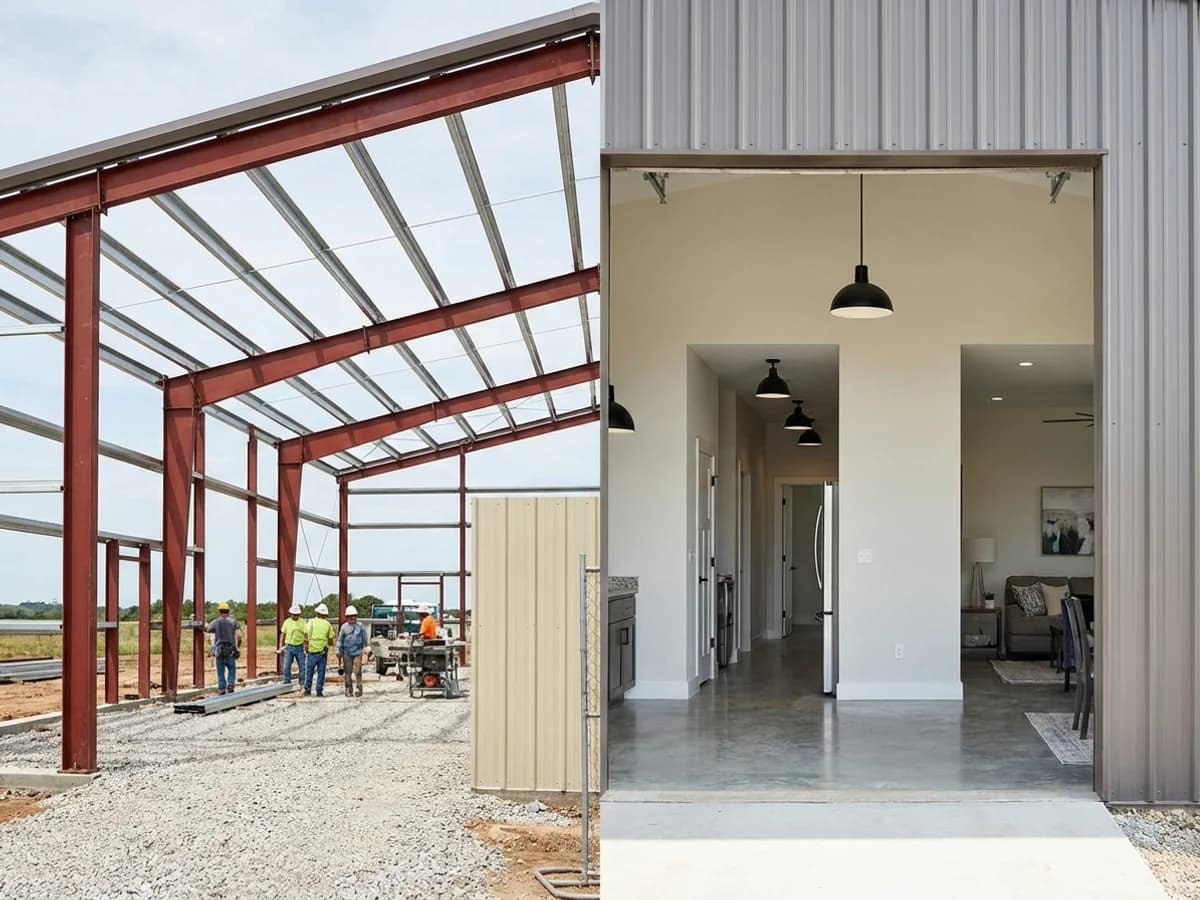
A barndominium is a steel-framed structure that combines living space with open-concept design, while a traditional home uses wood framing (stick-built construction). Barndominiums typically cost 10-12% less per square foot and can be built 20-30% faster than a comparable stick-built home, while offering superior resistance to fire, termites, rot, and severe weather.
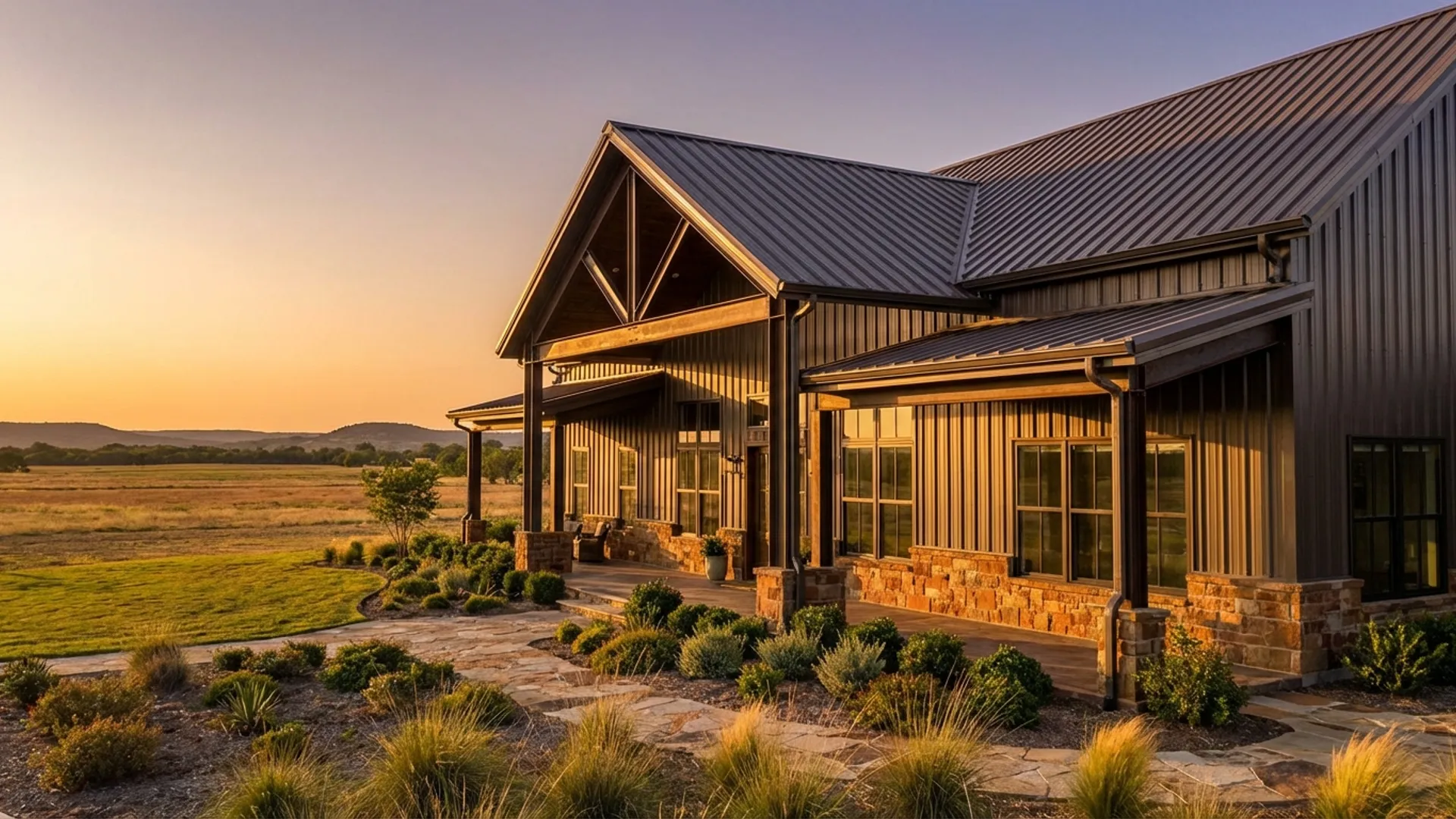
The term “barndominium” originally described converted agricultural barns repurposed as living space. Today it refers to purpose-built, steel-framed residential homes that use the same post-frame or rigid-frame construction methods found in commercial and agricultural buildings, but with fully finished residential interiors. For a deeper look at what defines a barndominium, how the construction process works, and why the building type has exploded in popularity, see our complete guide to barndominiums.
A traditional stick-built home uses dimensional lumber (2x4 or 2x6 studs) to create the structural frame, with plywood or OSB sheathing, and exterior cladding like vinyl siding, brick, or stucco. This method has been the standard in American residential construction for over a century and accounts for roughly 90% of all homes built in the United States.
The fundamental difference is the structural skeleton. Steel framing gives barndominiums clear-span interiors (no load-bearing walls needed), faster construction timelines, and inherent resistance to biological and fire damage. Wood framing gives traditional homes a familiar building process, widespread contractor availability, and universal market acceptance. Every other difference between these two building types flows from that core structural choice.
| Feature | Barndominium | Traditional Home |
|---|---|---|
| Structural Frame | Steel columns and rafters | Wood studs, headers, and trusses |
| Exterior Cladding | Steel panels (stone/brick veneer optional) | Vinyl siding, brick, stucco, or wood |
| Interior Walls | Non-load-bearing (layout only) | Mix of load-bearing and partition walls |
| Clear Span Capability | Up to 80+ feet without interior columns | Typically limited to 20-24 feet without beams |
| Fire Resistance | Steel is non-combustible | Wood is combustible; requires fire treatment |
| Termite Risk | Zero -- steel is inedible | High -- termites cause $5 billion+ in US damage annually |
| Foundation | Concrete slab (most common) | Slab, crawl space, or basement |
Understanding these structural differences is essential because they directly influence every cost, timeline, and maintenance comparison that follows. A barndominium is not simply a cheaper house -- it is a fundamentally different construction method that produces different economic outcomes at every stage of ownership.
How Do Building Costs Compare?
A mid-range finished barndominium costs $200-$234 per square foot at national averages, while a comparable traditional stick-built home costs $224-$262 per square foot. For a 2,000 square foot home, that translates to $400,000-$468,000 for a barndominium versus $448,000-$524,000 for a traditional build -- a savings of 10-12%.
The cost gap between barndominiums and traditional homes is not a marketing claim -- it is a structural reality driven by material efficiency, labor reduction, and construction speed. For a granular breakdown of barndominium pricing at every budget level, see our complete barndominium guide.
Side-by-Side Cost Comparison by Home Size
| Home Size | Barndominium (Mid-Range) | Traditional Home (Mid-Range) | Estimated Savings |
|---|---|---|---|
| 1,200 SF | $240,000 - $280,800 | $268,800 - $314,400 | $28,800 - $33,600 |
| 1,500 SF | $300,000 - $351,000 | $336,000 - $393,000 | $36,000 - $42,000 |
| 2,000 SF | $400,000 - $468,000 | $448,000 - $524,000 | $48,000 - $56,000 |
| 2,500 SF | $500,000 - $585,000 | $560,000 - $655,000 | $60,000 - $70,000 |
| 3,000 SF | $600,000 - $702,000 | $672,000 - $786,000 | $72,000 - $84,000 |
Where the Cost Savings Come From
The 10-12% savings of barndominium construction over stick-built homes are driven by four structural advantages:
- Material efficiency: Steel components are pre-engineered and factory-cut to exact specifications. Wood framing generates 10-15% material waste on site -- cut-off pieces, warped lumber, and damaged boards that go straight to the dumpster. Steel waste on a barndominium job site is near zero.
- Labor reduction: A steel frame can be erected in 1-3 days by a small crew with a crane, versus 2-4 weeks for a wood-framing crew to stick-build the same size structure. Fewer labor hours means lower labor costs.
- No load-bearing interior walls: Steel clear-span construction means every interior wall is a simple partition. There are no headers, no structural beams, and no engineered connections required inside the building. This simplifies and accelerates interior framing significantly.
- Reduced overhead: Faster construction means less time paying for project supervision, equipment rental, portable facilities, and construction insurance. A project that finishes in 4 months instead of 10 months carries substantially lower overhead costs.
Material Cost Breakdown
| Cost Category | Barndominium | Traditional Home |
|---|---|---|
| Structural frame | $25+/SF (steel) | $25 - $45/SF (lumber + sheathing) |
| Exterior cladding | $3 - $8/SF (steel panels) | $8 - $20/SF (siding, brick, or stucco) |
| Roofing | $3 - $6/SF (metal roof, integral) | $5 - $12/SF (sheathing + underlayment + shingles) |
| Foundation | $5 - $8/SF (slab) | $5 - $15/SF (slab, crawl space, or basement) |
| Interior finishing | $30 - $100+/SF | $40 - $120+/SF |
The structural frame and exterior cladding are where barndominiums gain the most ground. Interior finishing costs are more similar between the two building types because kitchens, bathrooms, flooring, and fixtures cost roughly the same regardless of what holds up the roof. The difference narrows at higher finish levels -- a luxury barndominium and a luxury stick-built home both spend heavily on premium interiors.
Barns & Barndos Insight: Our turnkey finish tiers start at $250/SF (Standard), $275/SF (High End), and $300/SF (Luxury). These are higher than the national mid-range average because they include galvanized steel framing, a 50-year PVDF exterior warranty, site-specific engineering, and interior finishes that compete with custom home construction. You are not comparing a basic barndominium to a basic house -- you are comparing a premium steel home to a premium stick-built home, and the steel version still costs less with superior durability.
Important: Barns & Barndos does not build builder-grade or low-end structures. We design and build premium steel homes engineered to last a lifetime and keep your family safe. Every project features custom design, professional-grade materials, and finishes that reflect the quality of a tailored home -- not a commodity product.
How Do Construction Timelines Compare?
A barndominium can be completed in 5-8 months from foundation pour to move-in day, while a traditional stick-built home takes 8-14 months for comparable size and finish level -- roughly 20-30% faster. The faster timeline is driven by pre-engineered steel components that arrive ready to assemble, eliminating weeks of on-site framing, sheathing, and weatherproofing.
Time is money in construction. Every additional month on the build timeline means another month of construction loan interest payments, another month of rent or temporary housing, and another month of exposure to material price increases and weather delays. The compressed barndominium timeline delivers savings beyond just the direct labor reduction.
Construction Phase Timeline Comparison
| Construction Phase | Barndominium | Traditional Home |
|---|---|---|
| Site prep and foundation | 2 - 4 weeks | 2 - 4 weeks |
| Structural framing | 1 - 3 days | 3 - 6 weeks |
| Exterior enclosure (roof + walls) | 1 - 2 weeks | 4 - 8 weeks |
| Rough-in (plumbing, electrical, HVAC) | 3 - 5 weeks | 4 - 6 weeks |
| Insulation and drywall | 2 - 4 weeks | 3 - 5 weeks |
| Interior finishing | 6 - 10 weeks | 6 - 12 weeks |
| Final inspections and punch list | 1 - 2 weeks | 2 - 4 weeks |
| Total | 5 - 8 months | 8 - 14 months |
Why Steel Construction Is Faster
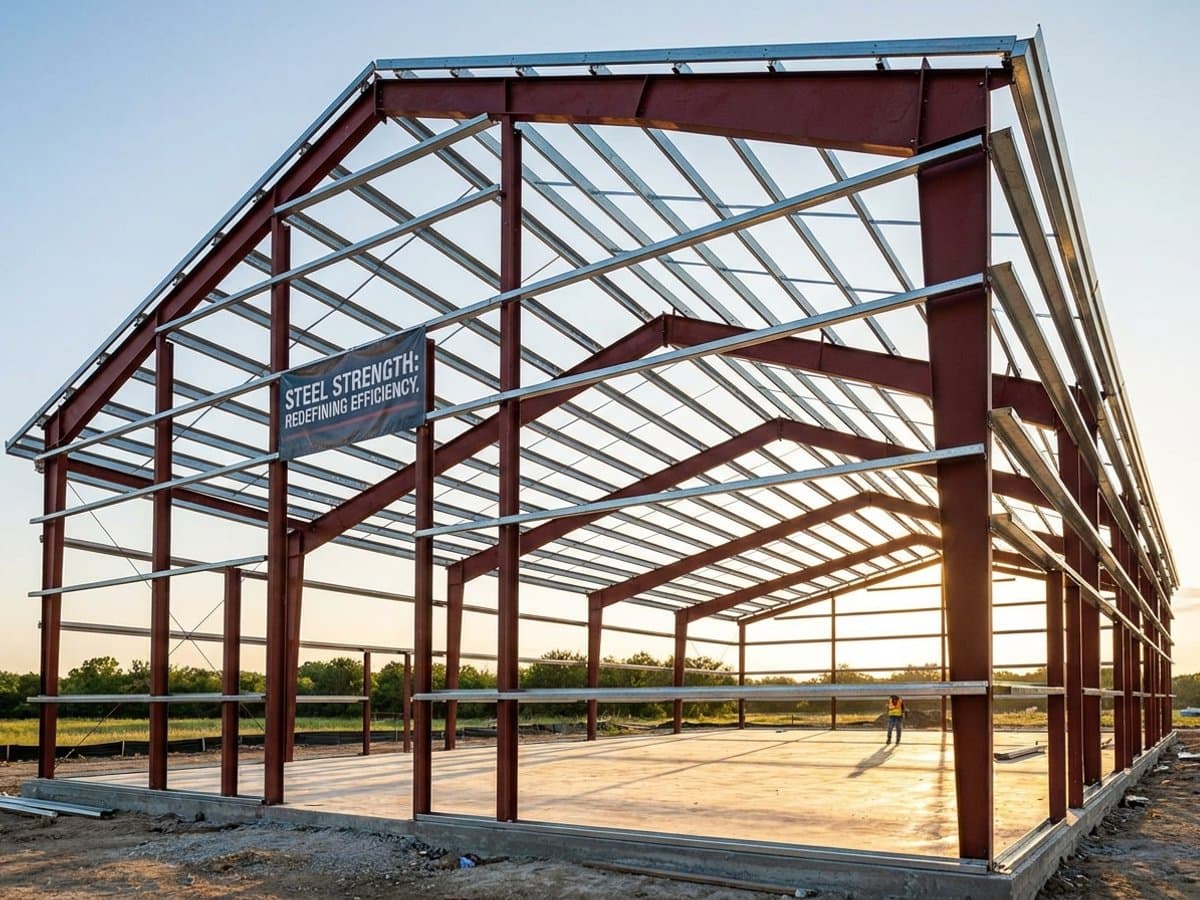
The biggest time savings happen during the framing and enclosure phases. A steel barndominium frame arrives at the job site as a kit of pre-cut, pre-drilled components with an assembly plan. A small crew with a crane can erect the primary frame (columns and rafters) in a single day and have the building fully enclosed with wall and roof panels within one to two weeks. At that point, the structure is weather-tight and interior trades can begin work immediately regardless of outdoor conditions.
By contrast, a traditional wood-framed home requires weeks of on-site cutting, nailing, sheathing, housewrap installation, and roofing before the interior is protected from weather. During that period, rain can soak framing lumber and subfloor sheathing, causing delays and potential moisture problems. A steel barndominium frame is unaffected by rain during the brief erection period, and once enclosed, the interior stays dry.
Timeline Savings: What They Mean Financially
- 4-8 fewer months of construction loan interest: At 8% on a $250,000 loan, that saves $6,600-$13,300 in interest payments alone
- 4-8 fewer months of temporary housing: At $1,500/month rent, that saves $6,000-$12,000
- Reduced exposure to material price increases: Lumber and steel prices can fluctuate 10-20% over a 12-month period
- Earlier occupancy: Move into your home sooner and start building equity instead of paying rent
How Do Maintenance Costs Compare Over Time?
Barndominiums have significantly lower long-term maintenance costs than traditional homes because steel framing is immune to termites, rot, mold, and warping. Over a 30-year ownership period, a barndominium owner can expect to spend $30,000-$60,000 less on structural maintenance compared to a wood-framed home.
The upfront cost comparison is only part of the story. The true cost of homeownership includes every dollar you spend maintaining the structure over decades. This is where steel construction pulls even further ahead of wood framing.
Steel vs. Wood: Long-Term Durability
Wood is a biological material. It absorbs moisture, expands and contracts with temperature changes, and is food for termites, carpenter ants, and wood-boring beetles. The National Pest Management Association estimates that termites cause over $5 billion in property damage across the United States every year. Wood also rots when exposed to sustained moisture, and mold can grow inside wall cavities if moisture barriers fail.
Steel is an inorganic material. It does not absorb moisture, does not attract insects, and does not rot. Galvanized steel (coated with zinc) resists corrosion for decades. PVDF (polyvinylidene fluoride) coated steel panels maintain their color and integrity for 50 years or more without repainting. A steel-framed barndominium will never need termite treatment, will never have a rotted sill plate, and will never develop wood-boring beetle damage.
30-Year Maintenance Cost Comparison
| Maintenance Item | Barndominium (30 Years) | Traditional Home (30 Years) |
|---|---|---|
| Termite prevention/treatment | $0 | $6,000 - $15,000 |
| Exterior repainting/re-siding | $0 (PVDF coating lasts 50+ years) | $12,000 - $30,000 (2-3 repaintings) |
| Roof replacement | $0 (metal roof lasts 40-70 years) | $10,000 - $25,000 (1 replacement at 20-25 years) |
| Rot/moisture repair | $0 | $3,000 - $15,000 |
| Structural settling/warping | $0 - $1,000 | $2,000 - $8,000 |
| HVAC, plumbing, electrical | $8,000 - $15,000 | $8,000 - $15,000 |
| Interior refreshing (paint, floors) | $10,000 - $20,000 | $10,000 - $20,000 |
| Estimated 30-Year Total | $18,000 - $36,000 | $51,000 - $128,000 |
The interior mechanical systems (HVAC, plumbing, electrical) and cosmetic refreshing (paint, flooring) cost roughly the same in both building types. The gap is entirely in the structural and exterior maintenance categories where steel's durability eliminates costs that wood-framed homeowners face repeatedly.
Barns & Barndos Insight: Our 50-year PVDF warranty on exterior panels is not just a selling point -- it is a tangible financial asset. A traditional homeowner will repaint their exterior two to three times over 30 years at $4,000-$10,000 each time. A Barns & Barndos owner spends zero on exterior panel maintenance during that same period. That single warranty eliminates $8,000-$30,000 in lifetime maintenance costs.
How Do Barndominiums Compare in Energy Efficiency?
Barndominiums can match or exceed the energy efficiency of traditional homes when properly insulated. Closed-cell spray foam insulation applied directly to steel panels achieves R-values of R-20 to R-40+ while creating a complete air and vapor barrier, resulting in estimated monthly utility savings of $50-$150 compared to a conventionally insulated wood-framed home.
Energy efficiency in any home depends more on insulation quality and air sealing than on the framing material. The common concern that “steel conducts heat” is valid at the molecular level but largely irrelevant in practice when proper insulation methods are used. A well-insulated barndominium performs thermally as well as or better than a well-insulated stick-built home.
Insulation Options for Barndominiums
| Insulation Type | R-Value Per Inch | Best Use | Cost (2,000 SF Home) |
|---|---|---|---|
| Closed-cell spray foam | R-6.5 to R-7 | Walls and roofline (preferred for steel) | $8,000 - $16,000 |
| Open-cell spray foam | R-3.5 to R-3.8 | Interior cavities, sound dampening | $4,000 - $8,000 |
| Fiberglass batts | R-3.1 to R-3.7 | Budget option, between purlins | $2,000 - $5,000 |
| Insulated metal panels (IMPs) | R-25 to R-45 (panel) | Premium wall/roof solution | $15,000 - $30,000 |
Closed-cell spray foam is the gold standard for barndominium insulation because it adheres directly to the steel panels, eliminates thermal bridging through the purlins and girts, creates a continuous air and vapor barrier, and provides structural rigidity. A 3-inch application of closed-cell spray foam delivers approximately R-20, while a 5-inch application reaches R-33 to R-35.
Traditional stick-built homes typically use fiberglass batt insulation between wall studs (R-13 to R-19 for 2x4 and 2x6 walls) and blown-in insulation in attic spaces (R-38 to R-60). While these methods are effective, they do not create the continuous air barrier that spray foam does in a steel building. Air infiltration through gaps, seams, and penetrations in batt insulation accounts for 25-40% of energy loss in a typical home.
Estimated Annual Utility Costs
A properly insulated 2,000 square foot barndominium with closed-cell spray foam, an energy-efficient HVAC system, and quality windows can expect annual heating and cooling costs of $1,200-$2,000, depending on climate zone and local energy prices. A comparably sized traditional home with standard fiberglass insulation typically runs $1,800-$3,000 per year. That $600-$1,000 annual savings adds up to $18,000-$30,000 over a 30-year ownership period.
Key Takeaways: Energy Efficiency
- Spray foam insulation is essential for barndominium energy performance -- it eliminates thermal bridging and air infiltration
- A well-insulated barndominium can match or beat the energy efficiency of a code-compliant stick-built home
- Annual utility savings of $600-$1,000 compound to $18,000-$30,000 over 30 years
- Insulation is not optional -- under-insulating a steel building leads to condensation, energy waste, and comfort problems
Can You Get a Mortgage on a Barndominium?
Yes, you can get a mortgage on a barndominium, but the process requires more planning than financing a traditional home. Most barndominiums are financed through construction-to-permanent loans, with USDA and FHA programs available for qualifying buyers. Construction loan interest rates run 1-2% higher than conventional mortgages, and down payments typically range from 0% (USDA) to 20-25% (conventional construction loans).
Financing is one of the most common concerns for prospective barndominium buyers, and for good reason -- it works differently than walking into a bank and applying for a standard home mortgage. The key difference is that you are financing a construction project, not an existing home, which introduces a different loan product and a different underwriting process.
We have written a comprehensive guide that walks through every financing option, lender strategy, and application tip in detail. See our complete guide to barndominium financing for the full breakdown. Here is a summary of how barndominium and traditional home financing compare:
| Financing Factor | Barndominium | Traditional Home |
|---|---|---|
| Primary loan type | Construction-to-permanent | Conventional mortgage |
| Typical down payment | 10 - 25% (construction); 0% (USDA) | 3 - 20% (conventional) |
| Interest rate (2026) | 7.5 - 9.5% (construction phase) | 6.5 - 7.5% (30-year fixed) |
| Lender availability | Fewer lenders experienced with barndos | Nearly all banks and credit unions |
| Appraisal challenge | Limited comparable sales in some areas | Abundant comparables |
| USDA eligible | Yes, in qualifying rural areas | Yes, in qualifying rural areas |
| FHA eligible | Yes, with approved builder | Yes |
The financing gap is narrowing. As barndominiums become more common, more lenders are developing products specifically for steel-frame residential construction. Credit unions and regional banks in states like Texas, Oklahoma, Florida, and Tennessee -- where barndominium construction is most active -- are often the most experienced and competitive lenders for these projects.
How Does Insurance Compare?
Barndominium insurance premiums are often comparable to or lower than traditional home insurance because steel construction is non-combustible and resistant to many perils that drive claims on wood-framed homes. However, not all insurance carriers write policies on barndominiums, so shopping around with agents experienced in steel-frame residential construction is essential.
Insurance is an ongoing ownership cost that compounds over decades, so even small premium differences add up. Steel construction offers inherent advantages in several risk categories that insurers evaluate when setting premiums.
Risk Factors That Favor Barndominiums
- Fire resistance: Steel framing is non-combustible. While interior contents can still burn, the structure itself does not contribute to fire spread. Many insurers recognize this with lower fire risk classifications.
- Wind resistance: Properly engineered steel buildings perform well in high-wind events. Bolted steel connections are stronger than nailed wood joints, and steel panels can be specified for wind ratings exceeding 150 mph.
- Pest damage: Termite damage is not typically covered by homeowner's insurance, but the absence of termite risk in steel construction eliminates a category of damage that wood-frame homeowners face.
- Water/moisture damage: Steel does not rot or develop mold in the way wood does, reducing the likelihood of moisture-related claims.
Insurance Challenges for Barndominiums
The primary challenge is finding a carrier willing to write the policy. Some insurance companies classify barndominiums as “non-standard” construction and either decline to insure them or charge higher premiums to account for unfamiliarity. The solution is to work with an independent insurance agent who can quote multiple carriers, or to contact companies that specialize in metal building insurance.
We cover barndominium insurance strategies, carrier recommendations, and cost-saving tips in detail in our upcoming barndominium insurance guide. For now, budget approximately $1,200-$2,500 per year for a standard barndominium homeowner's policy, which is comparable to the $1,500-$3,000 range for traditional homes.
Do Barndominiums Appraise the Same as Traditional Homes?
Barndominiums do not always appraise at the same value as comparable traditional homes, primarily because appraisers may have difficulty finding similar recently sold properties (comparables) in their market. However, this gap is narrowing rapidly as barndominium construction volume increases and more comparable sales data becomes available in MLS systems.
The appraisal is one of the most critical steps in barndominium ownership because it directly affects how much a lender will finance and how much equity you have on paper. Understanding how appraisals work -- and what you can do to ensure a fair valuation -- is essential.
Why Appraisals Can Be Challenging
Residential appraisals rely heavily on the sales comparison approach, which values a property based on recent sales of similar homes in the area. In regions where few barndominiums have been built and sold, appraisers simply do not have enough comparable sales to work with. When comparables are scarce, appraisers may:
- Use traditional homes as comparables and apply negative adjustments for the “non-traditional” construction type
- Widen their search radius to find barndominium sales, which may introduce market differences
- Rely more heavily on the cost approach (land value plus depreciated construction cost), which may not capture the full market value of a quality build
The Improving Trend
The good news is that barndominium appraisals are improving year over year. In Texas, Oklahoma, Tennessee, Florida, Georgia, and other states where barndominiums are popular, there are now enough comparable sales in many markets to support accurate valuations. Appraisers in these regions are increasingly familiar with steel-frame residential construction and recognize the value of features like PVDF-coated exteriors, spray foam insulation, and galvanized steel framing.
How to Maximize Your Appraisal
- Build to code with full permits: Unpermitted structures are extremely difficult to appraise and finance
- Use quality materials and professional finishing: A well-finished barndominium with quality flooring, cabinetry, and fixtures appraises significantly higher than a basic build
- Provide documentation: Give the appraiser your engineering drawings, material specifications, warranty information, and a cost breakdown. This helps them justify their valuation.
- Request an appraiser experienced with barndominiums: Your lender may allow you to request a specific appraiser or panel. Ask for someone who has appraised steel-frame residential properties before.
- Consider exterior finishes: Barndominiums with stone, brick, or stucco veneer on the exterior often appraise higher than all-metal exteriors because they present as more “traditional” to appraisers and buyers
Barns & Barndos Insight: Every Barns & Barndos project includes a complete documentation package -- structural engineering by licensed professionals, detailed material specifications, PVDF warranty documentation, and a full cost breakdown. This package gives appraisers the data they need to justify a fair market valuation. Our engineering team is licensed in all 48 states, and every build is fully permitted with all required inspections, which eliminates the most common appraisal obstacles.
Which Is Better for Resale Value?
Traditional homes currently have broader resale market appeal due to universal buyer familiarity, while barndominiums perform best in rural, exurban, and acreage markets where the building type is well-known and accepted. However, the resale gap is closing as barndominium popularity grows and more comparable sales data becomes available for accurate appraisals.
Resale value is the one category where traditional homes still hold a clear advantage in most markets. This is not because barndominiums are inferior structures -- it is because the resale market relies on buyer perception and appraiser data, both of which favor the building type that 90% of Americans are familiar with.
Where Barndominiums Resell Well
- Rural markets with acreage: In areas where 5-50+ acre properties are the norm, barndominiums are a well-known and desirable building type. Buyers in these markets specifically seek out steel-frame homes for their durability, low maintenance, and workshop/garage integration.
- States with high barndominium adoption: Texas, Oklahoma, Tennessee, Georgia, Florida, Alabama, and Arkansas have the highest concentration of barndominium construction. In these states, appraisers have comparables, buyers are familiar with the concept, and lenders have experience financing resales.
- Properties with quality construction: A barndominium built by a professional builder with full permits, quality finishes, and proper documentation resells at a premium compared to DIY builds with visible shortcuts.
Where Barndominiums Face Resale Challenges
- Suburban subdivisions: Neighborhoods with HOA restrictions and traditional architectural standards are generally not barndominium-friendly markets
- Urban areas: Metro markets where lot sizes are small and buyers expect traditional construction
- Regions with low barndominium prevalence: In the Northeast, Pacific Northwest, and parts of the Upper Midwest, few barndominiums have been built, which limits comparable sales data and buyer familiarity
Building for Maximum Resale
If resale value is a priority, these strategies help ensure your barndominium holds and builds value:
- Full permits and inspections -- Non-negotiable for resale financing
- Quality interior finishes -- Mid-range or better kitchens, bathrooms, and flooring
- Functional floor plan -- At least 3 bedrooms, 2 bathrooms, and an open living area
- Curb appeal -- Landscaping, a covered entry, and attractive exterior design (stone or brick accents improve perception)
- Documentation package -- Engineering plans, warranties, material specs, and inspection records
- Location selection -- Build in a market where barndominiums are already common and accepted
Which Should You Choose?
Choose a barndominium if you prioritize lower construction costs, faster build timelines, minimal long-term maintenance, and open-concept living -- especially if you are building on rural or acreage property. Choose a traditional home if you are building in a suburban subdivision, need maximum resale liquidity in a market unfamiliar with barndominiums, or prefer the widest possible range of contractors and lenders.
The right choice depends on your specific priorities, location, and long-term plans. There is no universally correct answer -- there is only the answer that best fits your situation. Use this decision matrix to clarify your best path:
Decision Matrix: Barndominium vs. Traditional Home
| Your Priority | Best Choice | Why |
|---|---|---|
| Lowest construction cost | Barndominium | 10-12% less per square foot than stick-built |
| Fastest build time | Barndominium | 5-8 months vs. 8-14 months (20-30% faster) |
| Lowest lifetime maintenance | Barndominium | Steel eliminates termite, rot, and exterior painting costs |
| Maximum open floor plan | Barndominium | Clear-span construction up to 80+ feet |
| Best severe weather resistance | Barndominium | Steel engineered for 150+ mph wind loads |
| Easiest financing | Traditional Home | More lender options, simpler loan products |
| Broadest resale market | Traditional Home | Universal buyer familiarity, abundant comparables |
| Suburban/HOA neighborhoods | Traditional Home | HOAs often restrict non-traditional construction |
| Workshop/garage integration | Barndominium | Open-span design naturally accommodates large work/storage areas |
| Energy efficiency | Tie (depends on insulation) | Both can achieve excellent performance with proper insulation |
The Bottom Line
For buyers building on rural or acreage property who want maximum value for their construction dollar, a barndominium is the stronger choice in almost every category. You get a more durable structure, built faster, for less money, with lower lifetime maintenance costs. The only real trade-off is a slightly more complex financing process and a resale market that, while improving rapidly, is still narrower than the universal traditional home market.
For buyers building in suburban subdivisions or urban areas where traditional construction dominates, a stick-built home is the safer choice from a financing and resale perspective -- even though it will cost more to build and more to maintain over time.
If you are leaning toward a barndominium and want to understand exactly what a turnkey steel home looks like at a premium level, explore our barndominium building services or learn more about what sets our builds apart on our Barns & Barndos advantage page.
Key Takeaways: Barndominium vs. Traditional Home
- Barndominiums cost 10-12% less than traditional homes at comparable finish levels, saving $30,000-$85,000 on a typical build
- Build timelines are 20-30% faster: 5-8 months for a barndominium versus 8-14 months for a traditional home
- 30-year maintenance savings of $30,000-$60,000+ thanks to steel's immunity to termites, rot, and exterior deterioration
- Energy efficiency is comparable when a barndominium uses spray foam insulation, with potential annual savings of $600-$1,000
- Financing requires more planning but is available through construction-to-permanent, USDA, and FHA loan programs
- Resale value favors traditional homes in suburban markets but is strong and improving in rural and acreage settings
- For rural and acreage buyers, a barndominium wins on cost, durability, timeline, and maintenance -- making it the stronger investment in most scenarios