What Is a Barndominium with Shop?
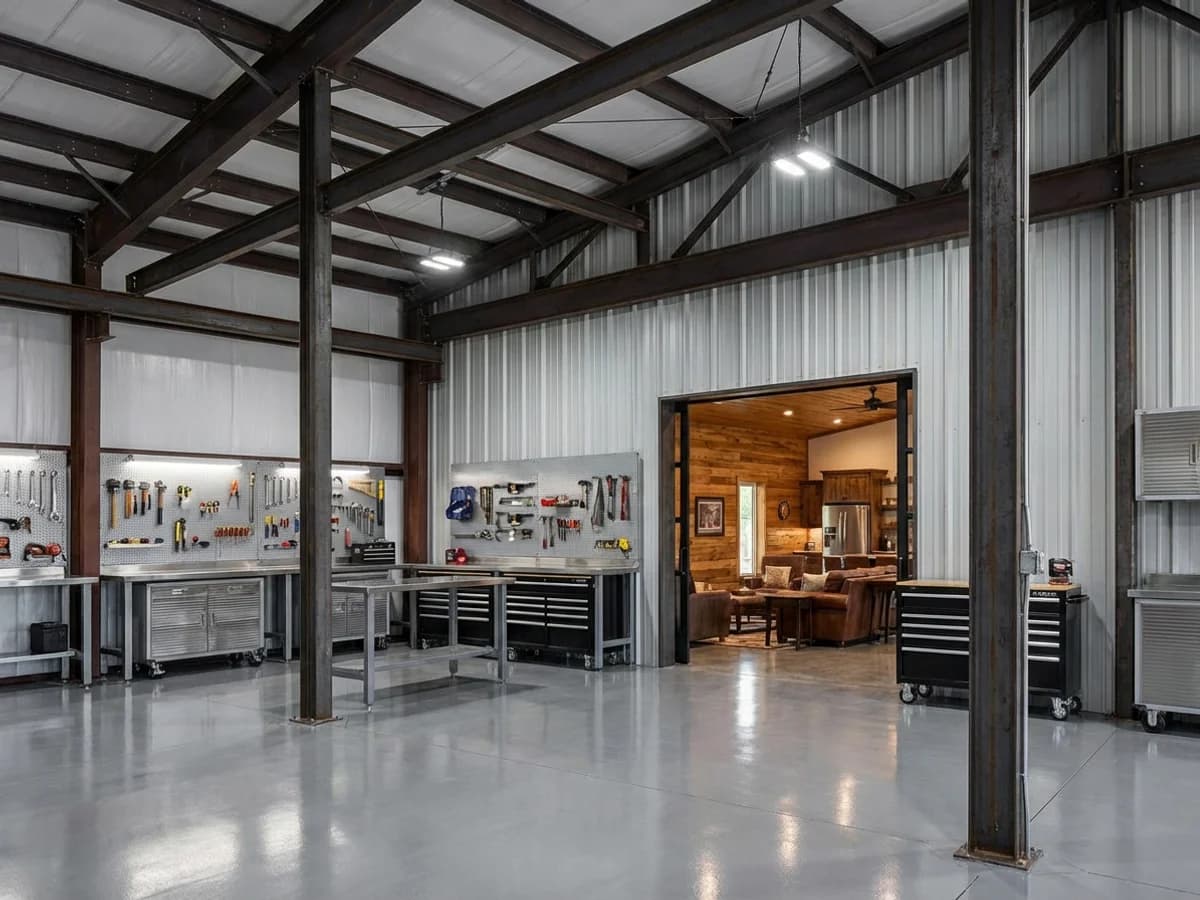
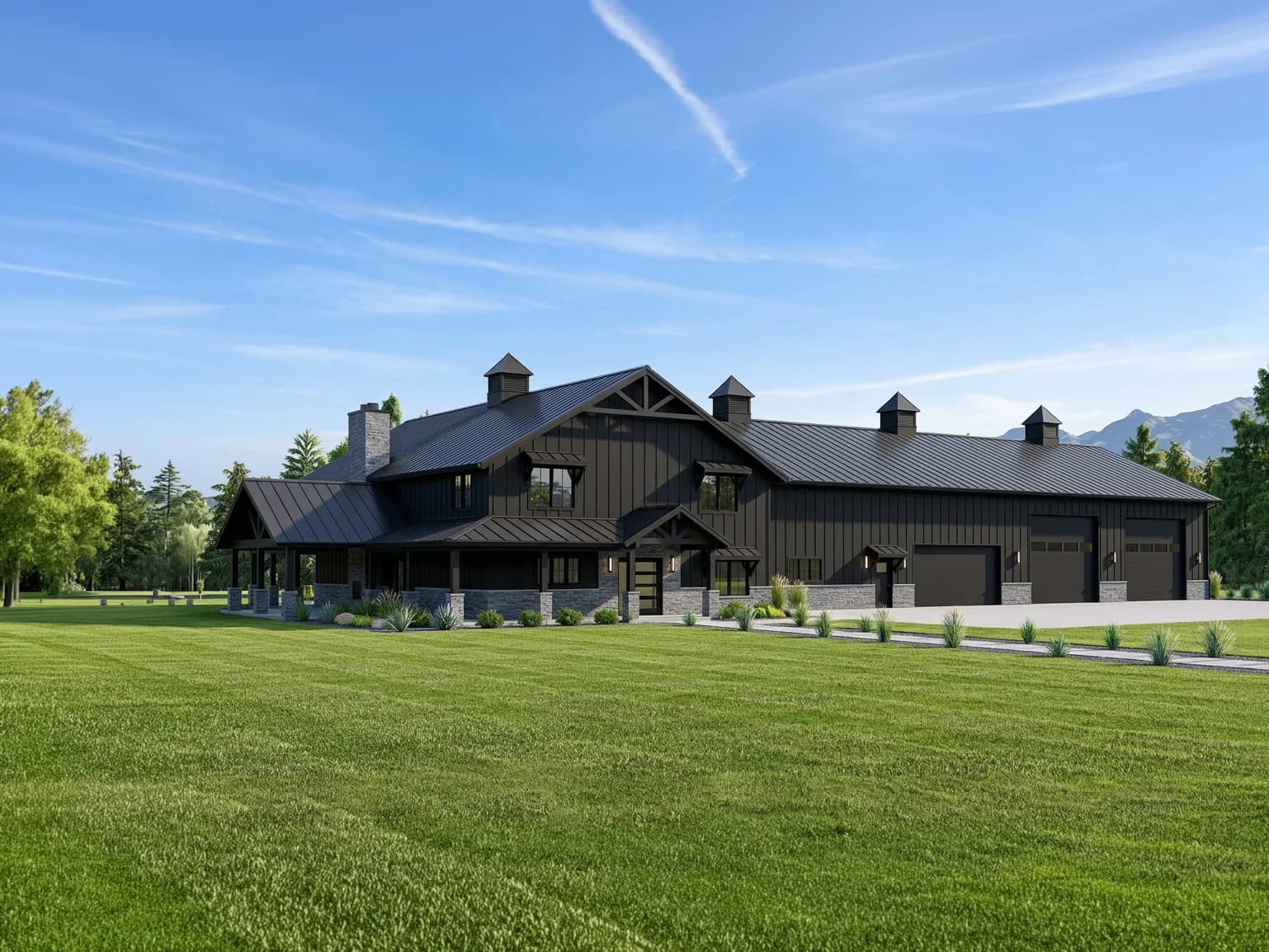
A barndominium with shop (sometimes called a “shouse”) combines a fully finished residential living space with an attached workshop, garage, or commercial workspace under one continuous steel-framed roof. This design eliminates the need for a separate outbuilding and is ideal for hobbyists, small business owners, car enthusiasts, and tradespeople.
The concept is straightforward: instead of building a house and then adding a detached garage or workshop on your property, you combine everything into a single steel structure. One foundation pour, one roof system, one set of utility connections -- and significantly lower total construction costs compared to building two separate structures. For a full overview of what barndominiums are and how they are built, see our complete guide to barndominiums.
The “shop” portion can serve virtually any purpose: a vehicle garage for cars, trucks, or RVs; a woodworking or metalworking workshop; an equipment storage bay for a contracting or landscaping business; a hobby space for restoration projects; or even a small commercial operation like a welding shop or auto detailing bay. The living side is a fully finished home with bedrooms, bathrooms, a kitchen, and all the amenities of conventional residential construction.
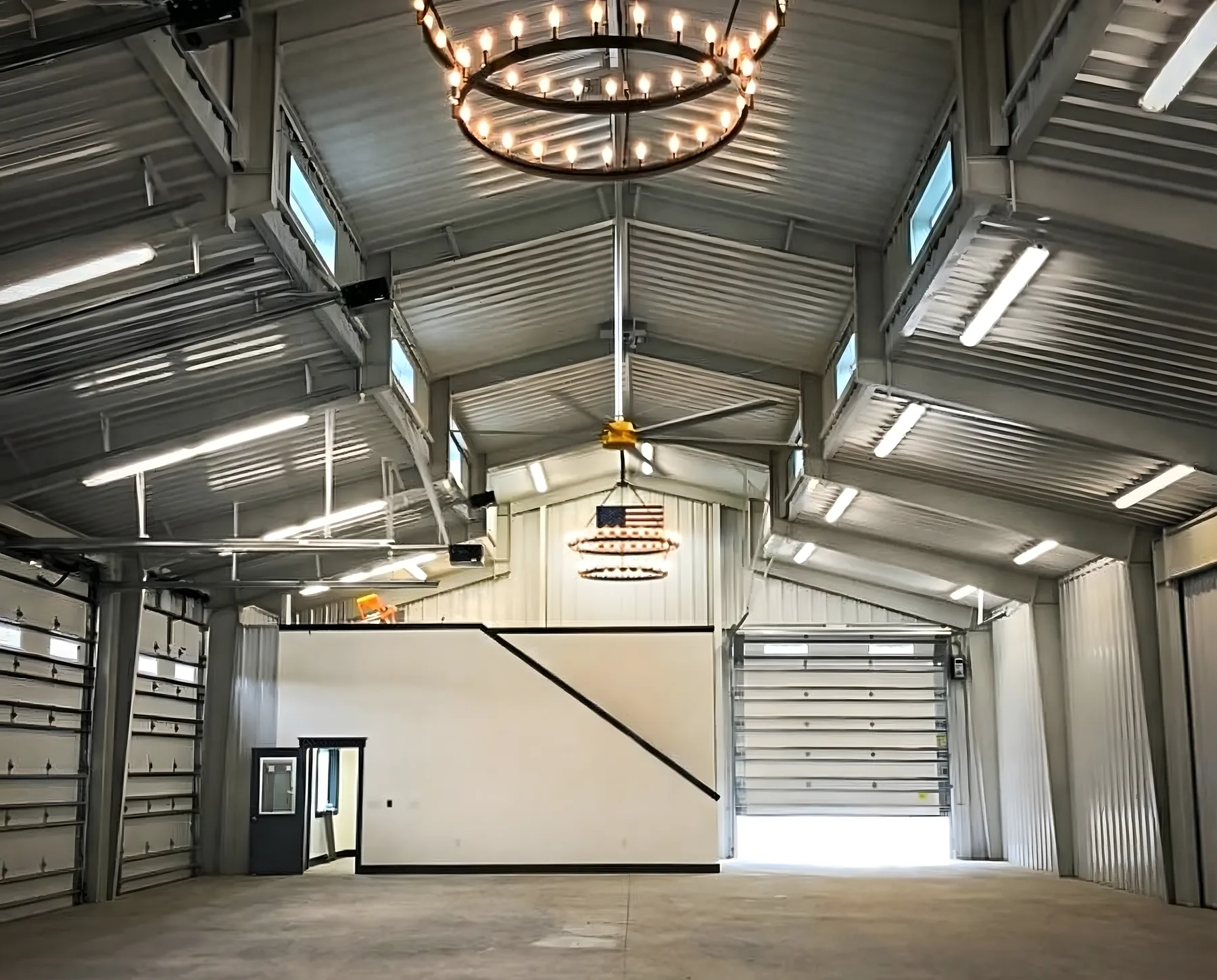
What makes the barndominium-with-shop concept work so well is the nature of steel clear-span construction. Unlike wood framing, steel allows wide open interior spans of 40, 60, or even 80+ feet without load-bearing interior walls or columns. This means you can allocate the interior space however you want -- 60% living and 40% shop, 50/50, or any other ratio -- and adjust the dividing wall location without structural limitations.
Barns & Barndos Insight: The most common regret we hear from barndominium shop owners is “I wish I had made the shop bigger.” Shop space fills up fast, especially once you add a workbench, tool storage, and a vehicle or two. We almost always recommend sizing up by at least 200 square feet from your initial estimate. The marginal cost of additional shell space is low compared to the value it adds.
What Are the Best Floor Plans for a Barndominium with Shop?
The best barndominium with shop floor plans use a side-by-side layout that divides living and workshop space along the length of the building with a shared interior partition wall. The four most popular configurations are the 40x60 split, the 40x80 split, the L-shaped design, and the full side-by-side layout.
Every shop barndominium floor plan revolves around one core decision: how to divide the space between living and working areas. The right layout depends on your shop use, how many people live in the home, and whether you need direct interior access between the two zones. For additional layout inspiration across all sizes, see our barndominium floor plans guide.
Layout 1: The 40x60 Split (60/40) -- Most Popular
The 40x60 barndominium is the most popular size for a combined shop-and-living build. At 2,400 total square feet, a 60/40 split gives you approximately 1,400 square feet of living space and 1,000 square feet of shop. The living side comfortably fits 2-3 bedrooms, 2 bathrooms, a full kitchen, and an open-concept living and dining area. The shop side accommodates 2-3 vehicles or a full workshop with storage.
- Living area: ~1,400 SF (2-3 bed / 2 bath)
- Shop area: ~1,000 SF (room for 2-3 vehicles or a full workshop)
- Overhead doors: Typically two 12x12 or one 14x14 roll-up
- Best for: Hobby mechanics, woodworkers, general workshop use
Layout 2: The 40x80 Split (50/50) -- Maximum Workshop
For owners who need a serious workspace, the 40x80 (3,200 SF) with a 50/50 split delivers 1,600 square feet on each side. The living area expands to a comfortable 3-4 bedroom home, while the shop side can handle a car lift, large equipment, or a commercial work bay with room to spare. This size is popular with auto enthusiasts, contractors, and small business owners who need their workspace close at hand.
- Living area: ~1,600 SF (3-4 bed / 2 bath)
- Shop area: ~1,600 SF (full car lift, equipment, storage)
- Overhead doors: Two 14x14 or one 14x16 roll-up
- Best for: Auto restoration, commercial contractors, equipment-heavy hobbies
Layout 3: The L-Shaped Design
An L-shaped barndominium places the shop wing perpendicular to the living wing, creating a natural separation between the two zones. This layout is ideal when you want maximum noise and smell isolation between living and working areas. The inside corner of the L often becomes a covered patio or breezeway, adding outdoor living space. The tradeoff is slightly higher construction cost due to the roofline transition at the junction.
- Living area: Varies (one wing is dedicated to the home)
- Shop area: Varies (the perpendicular wing is the workshop)
- Overhead doors: Face away from the living entry for clean curb appeal
- Best for: Owners who want visual and acoustic separation, larger lots
Layout 4: Side-by-Side with Center Partition
The simplest and most cost-effective layout runs a single partition wall down the center (or offset) of a rectangular building. Living space on one side, shop on the other, with a shared wall that includes an interior access door. This design keeps the roofline simple, minimizes structural complexity, and is the most affordable to build per square foot. It works well for any size from 30x50 up to 60x100+.
- Living area: One side of the partition (sized to your needs)
- Shop area: Opposite side of the partition
- Overhead doors: On the shop end wall or side wall
- Best for: Budget-conscious builds, straightforward construction, any lot size
| Layout | Total Size | Living SF | Shop SF | Best For | Relative Cost |
|---|---|---|---|---|---|
| 40x60 Split (60/40) | 2,400 SF | ~1,400 | ~1,000 | Hobby / general shop | $$ |
| 40x80 Split (50/50) | 3,200 SF | ~1,600 | ~1,600 | Auto / commercial | $$$ |
| L-Shaped | Varies | Varies | Varies | Noise separation | $$$$ |
| Side-by-Side | Varies | Varies | Varies | Budget builds | $ |
Key Takeaways: Shop Barndominium Floor Plans
- The 40x60 with a 60/40 split is the most popular and cost-effective shop barndominium layout for most owners
- Side-by-side layouts with a single partition wall are the simplest and cheapest to build
- L-shaped designs provide the best noise and odor separation but cost more due to roofline complexity
- Always include an interior access door between the shop and living areas for convenience and safety
How Big Should the Shop Area Be?
The ideal shop size in a barndominium depends on its intended use: hobby workshops need 400-800 square feet, vehicle storage and maintenance shops need 800-1,200 square feet, and commercial or multi-vehicle workshops need 1,200-2,000+ square feet. Ceiling height is equally important -- plan for a minimum of 12 feet for vehicle work and 14 feet if you want a car lift.
Shop sizing is one of the most consequential decisions in a barndominium build because it directly determines how much living space you have on the other side of the partition. Under-sizing the shop means constant frustration; over-sizing it means cramped living quarters. Here is a practical guide based on common shop activities:
Hobby and Light Workshop: 400-800 SF
If your shop will be used for woodworking, crafting, small engine repair, or general hobby work, 400-800 square feet is typically sufficient. This provides room for a workbench, tool storage, a table saw or drill press, and floor space for projects. A single 10x10 or 12x10 overhead door provides access for materials and small equipment.
Vehicle Storage and Maintenance: 800-1,200 SF
For storing and working on cars, trucks, ATVs, or motorcycles, plan for 800-1,200 square feet. A single car bay needs about 12x24 feet (288 SF), so two vehicles plus a workbench and tool area pushes you to 800-1,000 SF minimum. If you want a car lift, you need at least 14 feet of clearance and a thickened concrete slab at the lift location. Overhead door sizing should be at least 12x12 feet for standard vehicles; 12x14 feet for trucks and SUVs.
Commercial or Multi-Vehicle Workshop: 1,200-2,000+ SF
For a full commercial workspace, auto restoration shop, or multi-vehicle garage, plan for 1,200 square feet or more. This allows for multiple work bays, a dedicated parts and tool storage area, equipment like lifts, compressors, and welding stations, and adequate circulation space for safety. At this scale, you typically need two or more overhead doors (14x14 or 14x16) and may need a drive-through layout for large vehicles or trailers.
Overhead Door Sizing Guide
Overhead door size is one of the most common oversights in shop barndominium planning. Here are the standard sizes matched to their use:
| Door Size | Best For | Notes |
|---|---|---|
| 10x10 | ATVs, riding mowers, small equipment | Too small for most vehicles |
| 12x12 | Standard cars and trucks | Minimum for vehicle access |
| 12x14 | Lifted trucks, SUVs, tall vehicles | Most popular for shop barndominiums |
| 14x14 | Large trucks, equipment, boats on trailers | Commercial-grade access |
| 14x16 | RVs, box trucks, large trailers | Requires 18+ ft eave height |
Barns & Barndos Insight: Always size your overhead doors for what you might own in the future, not just what you own today. Upgrading from a 12x12 to a 14x14 door during initial construction adds only $500-$1,000. Retrofitting a larger door opening into an existing wall after the build can cost $3,000-$5,000+. The same applies to ceiling height -- it is dramatically cheaper to build taller from the start than to raise a roof later.
How Do You Separate Living Space from Shop Space?
Living and shop spaces in a barndominium are separated by a fire-rated partition wall (typically 2-hour rated with 5/8" Type X drywall on both sides), insulation for sound and thermal control, and independent HVAC systems for each zone. Proper separation prevents exhaust fumes, noise, dust, and temperature extremes in the shop from affecting the living area.
The partition wall between your shop and living space is one of the most important elements in the entire build. Done right, you will never hear the compressor kick on, never smell paint or exhaust in the kitchen, and never feel temperature swings from the shop side. Done poorly, every shop activity bleeds into your living environment.
Fire-Rated Partition Wall
Most building codes require a minimum 1-hour fire-rated separation between a residential space and an attached garage or workshop. Many builders recommend upgrading to a 2-hour rating for added safety. A 2-hour rated wall uses 2x6 or steel stud framing with two layers of 5/8" Type X (fire-rated) drywall on each side. The cost difference between a 1-hour and 2-hour wall is minimal ($1-$2 per square foot of wall area) and the additional protection is worth every dollar.
Sound Isolation
A fire-rated wall alone does not provide adequate sound isolation. To block shop noise from reaching the living area, add closed-cell spray foam insulation in the wall cavity (which doubles as thermal insulation), resilient channel (metal strips that decouple the drywall from the studs to reduce vibration transfer), and acoustical sealant at all edges, penetrations, and the floor-to-wall junction. A solid-core steel door with weatherstripping for the interior access point will outperform a hollow-core door by 15-20 decibels.
HVAC Separation
The living area and shop should have completely independent HVAC systems. The living side uses a standard residential HVAC system (central air, mini-split, or heat pump). The shop side uses a separate system appropriate to the space -- often a ductless mini-split for moderate climates or a gas-fired unit heater for cold-climate shops. Connecting both spaces to the same HVAC system would circulate shop dust, fumes, and odors directly into your home.
Ventilation and Exhaust
Every shop needs dedicated ventilation. At minimum, this includes an exhaust fan (sized to turn over the shop air volume at least once every 3-5 minutes) and intake vents to provide makeup air. If you plan to do painting, welding, or work with solvents, you may need a dedicated exhaust hood, a fresh-air filtration system, or a paint booth enclosure with its own ventilation. Carbon monoxide detectors are mandatory in any shop where engines will run.
Key Takeaways: Separating Shop from Living Space
- Fire-rated partition wall (2-hour rated with Type X drywall) is the minimum standard for safety and code compliance
- Sound isolation requires spray foam, resilient channel, and a solid-core access door -- a fire wall alone is not enough
- Separate HVAC systems are mandatory to prevent fumes and dust from entering the living space
- Dedicated shop ventilation with an exhaust fan and makeup air intake is essential for health and air quality
How Much Does a Barndominium with Shop Cost?
A barndominium with shop costs $130-$175 per square foot on average for the total building, with the shop portion costing significantly less per square foot ($40-$90/SF) than the finished living area ($200-$234/SF at national mid-range averages). A typical 40x60 shop barndominium with 1,400 SF of living space and 1,000 SF of shop totals $320,000-$420,000 at mid-range finish levels.
The cost advantage of a barndominium with shop comes from the shop portion requiring far less interior finishing than the living side. While the living area needs drywall, flooring, a kitchen, bathrooms, and full mechanical systems, the shop side typically gets a concrete slab floor (left exposed), insulated walls with minimal finishing, basic electrical and lighting, and overhead doors. This means the blended per-square-foot cost for the entire building is lower than a fully finished residential barndominium of the same size. For detailed pricing at every finish level, see our complete barndominium guide.
| Building Size | Layout | Living Cost (Mid-Range) | Shop Cost | Total Estimate |
|---|---|---|---|---|
| 30x50 (1,500 SF) | 900 SF living / 600 SF shop | $180,000 - $210,600 | $24,000 - $54,000 | $204,000 - $264,600 |
| 40x60 (2,400 SF) | 1,400 SF living / 1,000 SF shop | $280,000 - $327,600 | $40,000 - $90,000 | $320,000 - $417,600 |
| 40x80 (3,200 SF) | 1,600 SF living / 1,600 SF shop | $320,000 - $374,400 | $64,000 - $144,000 | $384,000 - $518,400 |
| 60x80 (4,800 SF) | 2,400 SF living / 2,400 SF shop | $480,000 - $561,600 | $96,000 - $216,000 | $576,000 - $777,600 |
These estimates cover the steel structure, foundation, interior finishing of the living area, basic shop finishing, overhead doors, and mechanical systems. They do not include land, site preparation, driveway, septic/well, or specialty shop equipment.
What Drives Shop Area Costs Up
While the shop portion starts at a lower per-square-foot cost than living space, several upgrades can push it higher:
- Car lift installation: A thickened, reinforced slab at the lift locations adds $2,000-$5,000 to the foundation; the lift itself runs $3,000-$10,000
- 220V / 50A electrical circuits: Heavy-duty wiring for welders, compressors, and lifts adds $1,500-$4,000 over basic shop electrical
- Compressed air system: A piped compressed air loop with drops at each workstation runs $2,000-$5,000 installed
- Epoxy or polyurea floor coating: $3-$8 per square foot, but adds durability, chemical resistance, and easier cleaning
- Larger or additional overhead doors: Each 14x14 or 14x16 insulated door costs $2,000-$5,000 installed
Turnkey Pricing from Barns & Barndos
For a premium turnkey shop barndominium from Barns & Barndos, the living portion is priced at our standard residential tiers ($250, $275, or $300 per square foot depending on the finish level), while the shop area is priced based on its specific finishing requirements. Our turnkey pricing includes galvanized steel framing, a 50-year PVDF warranty, full engineering, and all mechanical systems for both zones.
Barns & Barndos Insight: Building the shop as part of your barndominium from the start is almost always cheaper than constructing a separate detached workshop later. You save on a second foundation pour, a second set of utility connections, a separate permit, and the overhead of mobilizing a construction crew for a second project. We estimate the savings at 15-25% compared to building two separate structures of equivalent total size.
What Permits and Zoning Issues Apply?
A barndominium with shop typically requires a standard residential building permit if the shop is for personal use. However, if you plan to operate a commercial business from the shop, you may face mixed-use zoning restrictions, need a home occupation permit or conditional use permit, and may be classified differently for property tax and insurance purposes.
Permitting and zoning are the areas where a barndominium with shop can get complicated, and the rules vary significantly by county and municipality. The key question that determines your permit path is whether the shop is for personal use or commercial use.
Personal-Use Shop (Garage / Hobby Space)
If the shop is used for personal hobbies, vehicle storage, or home projects -- essentially functioning as an oversized attached garage -- it typically falls under standard residential permitting. Most jurisdictions allow attached garages and workshops as part of a residential building permit without additional zoning requirements. The shop area is included in the total building square footage on the permit application.
Commercial-Use Shop (Business Operation)
If you plan to run a business from the shop -- auto repair, welding, woodworking sales, contractor storage -- you enter mixed-use territory. Many residential zones allow home occupations with restrictions (no employees, no customer traffic, no signage, no hazardous materials). More intensive commercial use may require a conditional use permit, a zoning variance, or location in an area zoned for mixed residential/commercial use.
Insurance Implications
Your insurance classification depends on how the shop is used. A personal hobby shop is typically covered under a standard homeowner's policy, though you may need to increase your coverage limits to account for the additional square footage and the value of shop equipment and tools. A commercial shop operation will likely require a separate business liability policy or a commercial endorsement on your homeowner's policy. For more on barndominium insurance, read our barndominium insurance guide.
Property Tax Classification
In some jurisdictions, attached shop space is assessed at a lower rate than finished living space because it is classified as “unfinished” or “accessory” space. In others, all space under one roof is assessed at the residential rate regardless of finish level. Check with your county assessor before building to understand how the shop area will be taxed. This can make a meaningful difference in your annual property tax bill.
Barns & Barndos Insight: We always recommend checking with your local planning and zoning office before finalizing your floor plan. A 15-minute phone call can prevent thousands of dollars in permitting headaches. Our engineering team prepares permit-ready drawings that meet local code requirements in all 48 states, which significantly streamlines the approval process.
Important: Barns & Barndos does not build builder-grade or low-end structures. We design and build premium steel homes engineered to last a lifetime and keep your family safe. Every project features custom design, professional-grade materials, and finishes that reflect the quality of a tailored home -- not a commodity product.
What Utilities Does a Barndominium Shop Need?
A barndominium shop requires heavy-duty electrical service (220V/50A minimum for equipment), adequate lighting (50+ foot-candles at work surfaces), dedicated ventilation with an exhaust fan, and a heating/cooling system independent from the living area. Optional but common additions include compressed air lines, a floor drain, and hot and cold water for a utility sink.
Utility planning for the shop side is where many barndominium builds go wrong. The living area has well-established requirements -- every electrician and plumber knows how to wire and plumb a house. But shop utilities require specific planning based on the equipment you will use. Here is what to spec during the design phase:
Electrical
The shop electrical system is the most critical utility to plan correctly. At minimum, you need a dedicated subpanel (100-200 amp depending on equipment load) fed from the main electrical service. Plan for:
- 220V/50A circuits: Required for welders, large compressors, car lifts, and plasma cutters. Plan at least two dedicated 220V circuits even if you only need one now.
- 120V/20A circuits: Multiple circuits for general-purpose outlets. Place duplex outlets every 6 feet around the perimeter and at each workstation. Avoid daisy-chaining shop tools on a single circuit.
- Lighting: LED shop lights rated at 50+ foot-candles at work height. A 1,000 SF shop typically needs 8-12 four-foot LED fixtures. Include task lighting at workbench areas.
- Exterior circuits: At least one GFCI-protected exterior outlet near each overhead door for power washing, outdoor work, or charging.
Compressed Air
If you will use pneumatic tools, a paint sprayer, or air-powered equipment, plan a compressed air system during construction. The most effective approach is a ceiling-mounted or wall-mounted piped loop with drop-down hose connections at each workstation. Running air lines during construction (before walls are finished) costs a fraction of retrofitting them later. A quality shop compressor (60-80 gallon, two-stage) runs $1,000-$3,000; the piping and drops add $1,000-$2,500.
Water and Drainage
A utility sink with hot and cold water is highly recommended for any shop. Running water supply lines to the shop during construction is inexpensive because the plumbing rough-in for the living area is already happening. A floor drain is valuable for vehicle maintenance shops and any workspace where fluids will be used. If you plan to wash vehicles indoors, a trench drain at the overhead door threshold prevents water from pooling. Note that floor drains connected to a septic system may have restrictions on what can be drained -- oil and chemical separators may be required.
Heating and Cooling
Shop climate control is a separate system from the living area. The most common options are:
- Radiant tube heaters: Gas-fired, mounted at ceiling height. Excellent for large open shops because they heat objects (including the floor slab), not just the air. Cost: $1,500-$4,000 installed.
- Ductless mini-split heat pumps: Provide both heating and cooling. Best for moderate climates and shops under 1,200 SF. Cost: $1,500-$4,000 installed.
- Forced-air unit heaters: Propane or natural gas. Affordable and effective for heating only. Cost: $500-$2,000 installed.
- In-slab radiant heat: Hydronic tubes embedded in the concrete slab. The most comfortable option (warm floors in winter) but must be installed during the foundation pour. Cost: $6-$12 per square foot.
Ventilation
Beyond the exhaust fan discussed in the separation section, consider the specific ventilation needs of your shop activities. Welding requires a dedicated fume extractor at each welding station. Painting requires a ventilated spray area or enclosed paint booth. Woodworking benefits from a dust collection system piped to each major tool. Plan these systems during the design phase so electrical, ducting, and wall penetrations are accounted for.
Can You Run a Business from a Barndominium Shop?
Yes, you can run a business from a barndominium shop, but it requires compliance with local zoning regulations, a home occupation permit (in most jurisdictions), appropriate business insurance, and potentially a commercial-grade build-out of the shop area. The feasibility depends heavily on your location's zoning classification and the type of business you plan to operate.
Running a business from your barndominium shop is one of the biggest practical advantages of this building style. Eliminating a separate commercial lease saves $1,000-$5,000+ per month in overhead, and your commute is a walk across the partition wall. But you need to set it up correctly from both a legal and a practical standpoint.
Zoning and Legal Requirements
Most residential zones allow “home occupations” under specific conditions. Common restrictions include:
- No employees working on the premises (or a limited number, often 1-2)
- No customer foot traffic or retail sales from the property
- No exterior signage or commercial-scale exterior changes
- No storage of hazardous materials beyond household quantities
- Noise levels that do not exceed residential standards at the property line
- Business activity confined to a specific percentage of the total building area
If your business exceeds these thresholds -- for example, an auto repair shop with customer vehicles, a welding operation with employees, or a retail storefront -- you will likely need property zoned for commercial or mixed use. Some counties offer agricultural or rural designations that are more permissive for shop-based businesses.
Insurance for Business Use
A standard homeowner's policy does not cover business activities or business property. If a customer is injured on your property during a business interaction, or if business equipment is damaged, your homeowner's policy may deny the claim. At minimum, you need a business liability policy ($500-$2,000 per year for most small operations) and may want commercial property coverage for shop equipment and inventory.
Practical Build-Out Considerations
If you know from the start that you will operate a business from your barndominium shop, design accordingly:
- Separate entrance: A dedicated shop entrance that does not require walking through the living area is essential for professionalism and security
- Customer-facing area: Even a small reception or consultation space (100-200 SF) with a desk, seating, and a restroom makes a strong impression
- Adequate parking: Plan for employee and customer parking beyond your personal vehicles
- Signage and visibility: If zoning allows, a professional sign at the road increases credibility and discoverability
- Security: Commercial-grade locks, a camera system, and adequate exterior lighting protect your business assets
Best Businesses for a Barndominium Shop
The businesses that work best in a barndominium shop setting are those that benefit from large, open work areas with vehicle access. Common examples include:
- Auto detailing and paint correction
- Custom fabrication and welding
- Woodworking and custom furniture building
- Small engine and equipment repair
- Contractor and trades base of operations (HVAC, electrical, plumbing)
- Vehicle restoration and customization
- Screen printing, sign making, and CNC operations
For a broader view of how long a barndominium takes to build, including the additional time for shop-specific features like thickened slabs and commercial electrical, see our construction timeline guide. Planning for business use from the start adds little to the overall timeline but saves significant expense and hassle compared to retrofitting later.
Key Takeaways: Barndominium with Shop
- A barndominium with shop combines living space and workspace under one steel roof, typically in a 60/40 or 50/50 split
- The 40x60 (2,400 SF) is the most popular shop barndominium size, delivering ~1,400 SF of living and ~1,000 SF of shop space
- Shop space costs less to build than living space ($40-$90/SF vs. $200-$255/SF at national averages) because it requires minimal interior finishing
- Proper separation with a fire-rated wall, sound isolation, and independent HVAC is essential for comfort and safety
- Plan shop utilities upfront -- 220V/50A electrical, compressed air, ventilation, and drainage are far cheaper to install during construction
- Running a business from your shop is possible but requires zoning compliance, proper insurance, and a commercial-grade build-out
- Building the shop as part of the barndominium saves 15-25% compared to constructing a separate detached workshop