What Is the Average Barndominium Build Time?
A barndominium takes 5 to 8 months to build from design to move-in, compared to 8-14 months for a traditional stick-built home. The steel shell can be manufactured in 4-8 weeks and erected in 2-6 weeks, with interior finishes adding 6-10 weeks depending on the chosen finish tier.
One of the biggest advantages of barndominium construction is speed. Steel buildings go up faster than wood-framed homes because the structural components are pre-engineered and manufactured in a controlled factory environment, then bolted together on site. There is no waiting for lumber deliveries, no cutting rafters on a job site, and no framing crew spending weeks assembling walls stick by stick.
For a complete overview of what barndominiums are, how they are constructed, and why steel framing is gaining ground in residential building, see our complete guide to barndominiums. This article focuses specifically on the construction timeline: how long each phase takes, what causes delays, and how to keep your project moving efficiently.
Here is a high-level view of what the typical barndominium build schedule looks like from start to finish:
| Construction Phase | Typical Duration | Cumulative Timeline |
|---|---|---|
| Design and engineering | 3 - 5 weeks | Weeks 1 - 5 |
| Permitting | 2 - 8 weeks | Weeks 3 - 10 (overlaps) |
| Fabrication and delivery | 4 - 8 weeks | Weeks 6 - 16 |
| Site prep and foundation | 2 - 4 weeks | Weeks 10 - 16 |
| Steel erection | 2 - 6 weeks | Weeks 12 - 20 |
| Interior finishes | 6 - 10 weeks | Weeks 16 - 32 |
| Total | 20 - 32 weeks | 5 - 8 months |
The wide range exists because every project is different. A 1,200 square foot barndominium with standard finishes on a flat, permitted lot in a rural county can genuinely be completed in about 5 months. A 3,500 square foot custom barndominium with luxury finishes, a complex floor plan, and a jurisdiction that requires extensive plan review will take closer to 8 months or slightly longer.
Barns & Barndos Insight: Our 5-phase build process overlaps activities wherever possible to compress the timeline. While the steel is being fabricated, we are simultaneously completing permitting and site preparation. This parallel approach typically saves 3-6 weeks compared to builders who run every phase sequentially.
What Are the Phases of Barndominium Construction?
Barndominium construction follows five main phases: design and engineering, fabrication and delivery, site preparation and foundation, steel shell erection, and interior finishing. A turnkey builder manages all five phases as one coordinated project, while owner-builders typically hire separate contractors for each phase.
Understanding these phases helps you plan your project realistically, set expectations with your builder, and identify where delays are most likely to occur. Each phase has its own timeline, cost drivers, and dependencies on the phases before and after it.
At Barns & Barndos, we use a structured 5-phase process that keeps every project on track from the first design meeting through move-in day. Here is how our process maps to the standard construction phases:
| Barns & Barndos Phase | What Happens | Duration |
|---|---|---|
| Phase 1: Design | Custom floor plan creation, 3D renderings, finish tier selection, site evaluation | 14 business days |
| Phase 2: Engineering | Structural engineering by state-licensed professionals, load calculations, foundation design, stamped plans for permitting | 2 - 3 weeks |
| Phase 3: Fabrication | Steel components manufactured to spec, galvanized framing, PVDF-coated panels cut and formed, quality control inspection | 4 - 8 weeks |
| Phase 4: Erection | Foundation pour (concurrent with fabrication), steel shell assembly, roof and wall panel installation, exterior trim and doors | 2 - 6 weeks |
| Phase 5: Finishing | Insulation, interior framing, drywall, plumbing and electrical rough-in and finish, HVAC, flooring, cabinetry, fixtures, final inspections | 4 - 8 weeks |
The key to a fast barndominium build is how these phases connect. Delays in one phase cascade into every subsequent phase. A two-week delay in permitting pushes fabrication back two weeks, which pushes erection back two weeks, and so on. Turnkey builders mitigate this risk by managing the entire process and overlapping phases where possible.
Key Takeaways: Barndominium Construction Phases
- 5 main phases from design through interior finishing, each with its own timeline
- Turnkey builders overlap phases to compress the total schedule by 3-6 weeks
- Permitting is the wildcard -- it varies the most by location and is the most common source of unexpected delays
- Each phase depends on the one before it -- delays cascade through the entire project if not managed proactively
How Long Does the Design and Engineering Phase Take?
The design and engineering phase for a barndominium takes 3 to 5 weeks total. Custom floor plan design typically requires 7-10 business days, while structural engineering by a licensed professional takes an additional 2-3 weeks. These two activities can partially overlap if the builder and engineer work in coordination.
Design is where your barndominium goes from an idea to a buildable plan. This phase determines your floor plan layout, structural requirements, finish selections, and the engineering specifications that your permitting authority needs to approve the project.
At Barns & Barndos, the design phase begins with a consultation to understand your needs: number of bedrooms and bathrooms, desired square footage, garage or shop space, ceiling height preferences, and your chosen finish tier (Standard at $250/SF, High End at $275/SF, or Luxury at $300/SF). From there, our team produces custom plans within 14 business days.
What Happens During Design
- Floor plan layout based on your requirements and lot dimensions
- Exterior elevation drawings showing the completed building
- 3D renderings to visualize the final result before construction starts
- Finish material selections and specification sheets
- Preliminary cost estimate based on your design and chosen finish tier
What Happens During Engineering
- Structural load calculations for your specific location (wind, snow, seismic)
- Foundation design including anchor bolt layout and concrete specifications
- Connection details for all structural steel members
- Stamped engineering drawings for building permit submission
- Compliance verification with local building codes and standards
Engineering is not optional. Every barndominium needs structural engineering by a professional licensed in the state where you are building. Barns & Barndos has engineers licensed in all 48 states, so there is no delay in finding an engineer who can stamp your plans for your jurisdiction.
Barns & Barndos Insight: The most common design-phase delay we see is indecision. Clients who change their floor plan multiple times during the design process can add 2-4 weeks to this phase. We recommend having your must-have list finalized before design begins: number of bedrooms, number of bathrooms, approximate square footage, and whether you need attached garage or shop space. Changes are much easier and less expensive to make on paper than during construction.
How Long Does Fabrication and Delivery Take?
Steel fabrication for a barndominium takes 4 to 8 weeks from the time engineering is finalized and the order is placed. Delivery adds 1-2 weeks depending on your distance from the manufacturing facility. Fabrication lead times vary by season, with spring and summer typically having longer backlogs due to higher demand.
Fabrication is the phase where your barndominium physically comes into existence. The factory takes the engineered drawings and manufactures every steel component to exact specifications: primary framing columns and rafters, secondary framing (girts and purlins), wall and roof panels, trim, fasteners, and all connection hardware.
Unlike wood framing where lumber is cut and assembled on site, pre-engineered steel buildings arrive at your job site ready to bolt together. Every piece is labeled, every hole is pre-drilled, and every connection point is designed to match the engineering drawings exactly. This factory precision is what makes on-site erection so much faster than traditional framing.
Factors That Affect Fabrication Time
- Building size and complexity: A simple 30x50 rectangular building fabricates faster than a 60x80 building with multiple rooflines and specialized openings
- Seasonal demand: Manufacturers are busiest in spring and early summer. Ordering in fall or winter often results in shorter lead times
- Material availability: Steel market conditions fluctuate. During supply chain disruptions, fabrication lead times can extend to 10-12 weeks
- Customizations: Special features like oversized doors, crane beams, or unusual panel colors may add fabrication time
Why Fabrication Time Is Actually an Advantage
While 4-8 weeks of fabrication might sound like a long wait, this is productive time. While your steel is being manufactured, your builder should be completing permitting, preparing the site, and pouring the foundation. A well-managed project uses fabrication time to get everything else ready so that erection can begin immediately when the steel arrives. This is how turnkey builders compress the overall timeline.
Barns & Barndos Insight: We use galvanized steel framing and PVDF-coated exterior panels on every build. Galvanization adds a small amount of time to the fabrication process, but it delivers decades of corrosion resistance that painted steel simply cannot match. Combined with our 50-year PVDF warranty on exterior finishes, these material choices mean you spend a few extra days in fabrication but gain a lifetime of reduced maintenance.
How Long Does It Take to Erect a Barndominium Shell?
A barndominium steel shell takes 2 to 6 weeks to erect once the foundation is cured and the steel components are delivered. A small to mid-size barndominium (1,500-2,500 square feet) with a simple gable roof can be erected in as little as 2-3 weeks. Larger buildings with complex rooflines, multiple openings, or multi-story designs may take 4-6 weeks.
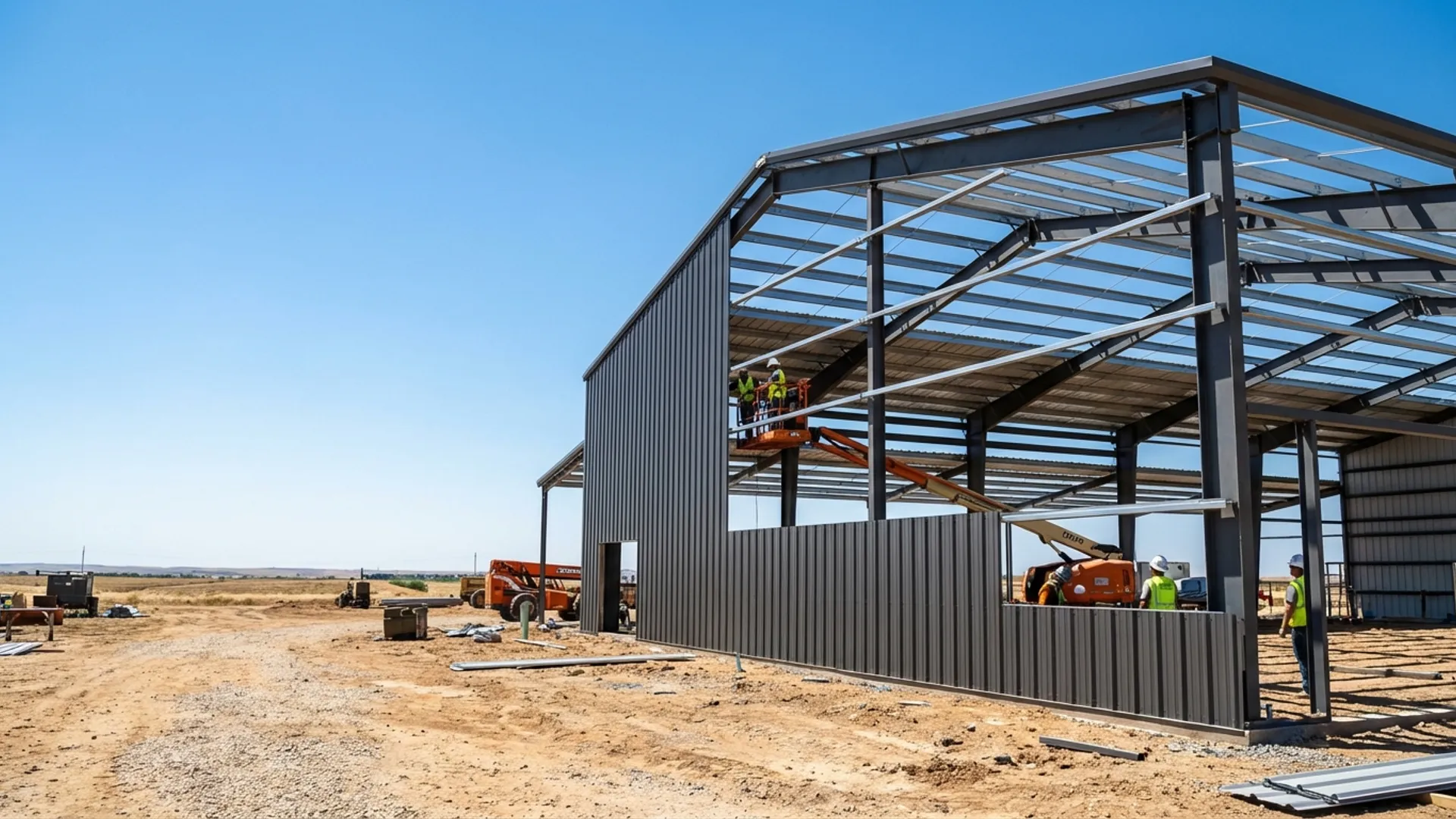
Shell erection is the most visually dramatic phase of barndominium construction. Your building goes from a concrete slab to a fully enclosed structure in a matter of weeks. This is the phase where the speed advantage of steel construction is most obvious -- a comparable wood-framed home would take 4-8 weeks just for the framing, sheathing, and exterior cladding.
What Happens During Erection
- Anchor bolt verification: The crew checks that all anchor bolts in the foundation are positioned correctly per the engineering drawings
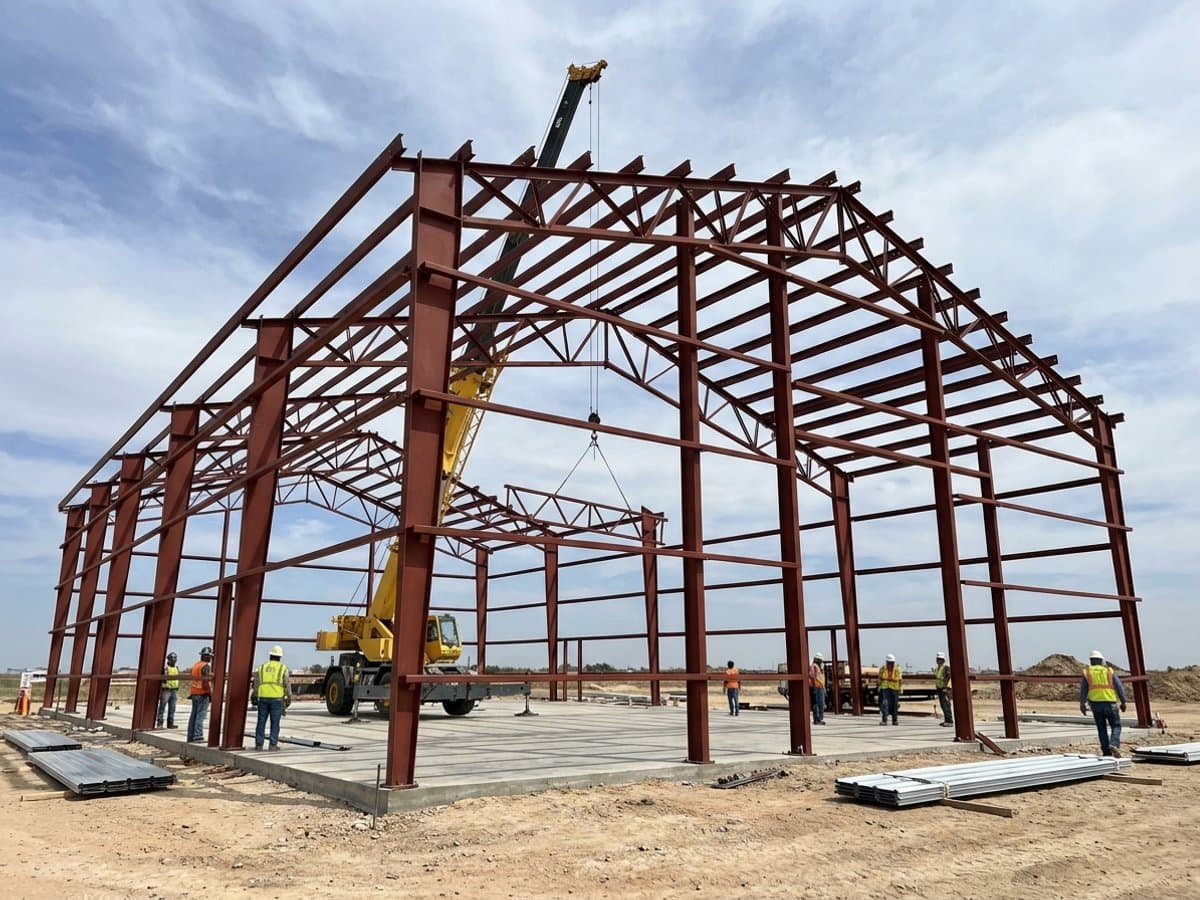
- Primary frame assembly: Main columns and rafters are lifted into place and bolted to the foundation anchors (typically 1-3 days for a residential building)
- Secondary framing: Girts (wall members) and purlins (roof members) are attached to the primary frame, creating the skeleton for wall and roof panels
- Wall panel installation: Exterior wall panels are fastened to the girts, enclosing the building
- Roof panel installation: Roof panels are fastened to the purlins, making the building weather-tight
- Trim and flashing: Ridge caps, corner trim, base trim, and flashing around openings are installed to seal all joints
- Doors and windows: Pre-framed openings receive their doors and windows
Foundation Requirements Before Erection
The concrete slab must reach a minimum of 75% of its design strength before erection begins. In practice, this means waiting at least 7 days after the pour, with most builders preferring a 14-28 day cure period. Temperature matters: concrete cures faster in warm weather (70-80 degrees Fahrenheit) and slower in cold weather. A foundation poured in January in a northern state may need 4 weeks to reach adequate strength, while the same pour in July in Texas might be ready in 10 days.
The erection phase is also where the choice between a turnkey barndominium builder and a DIY approach matters most. Experienced steel erection crews work efficiently because they assemble these buildings regularly. An inexperienced crew or an owner-builder attempting their first steel erection can easily take 2-3 times longer and risk costly mistakes in structural connections.
How Long Do Interior Finishes Take?
Interior finishing for a barndominium takes 6 to 10 weeks depending on the size of the building and the complexity of finishes selected. Standard finishes can be completed in 6-7 weeks, while high-end and luxury finishes with custom cabinetry, natural stone, and specialty materials typically take 8-10 weeks or longer.
Interior finishing is the longest single phase of barndominium construction and the phase where the most trades are involved. It is also the phase with the most variation in timeline, because finish selections have a direct impact on how long the work takes.
Understanding the order of interior finishing work helps you see why this phase takes the time it does. Each step must happen in sequence because later work depends on earlier work being complete.
Interior Finishing Sequence
- Insulation (3-5 days): Spray foam or fiberglass insulation is installed in walls and ceiling. Spray foam is faster and more effective but costs more.
- Rough-in plumbing and electrical (1-2 weeks): All pipes, drain lines, wiring, and junction boxes are installed inside the walls before they are closed up. This is inspected before proceeding.
- HVAC rough-in (3-5 days): Ductwork, refrigerant lines, and the air handler location are installed. This runs concurrently with plumbing and electrical in many builds.
- Interior framing and drywall (1-2 weeks): Non-load-bearing partition walls are framed, drywall is hung, taped, mudded, and sanded. This is typically two separate visits with drying time between coats.
- Painting (3-5 days): Interior walls and ceilings are primed and painted.
- Flooring (3-7 days): Hardwood, tile, luxury vinyl plank, or polished concrete flooring is installed throughout the home.
- Cabinetry and countertops (3-7 days): Kitchen and bathroom cabinets are installed, followed by countertop templating, fabrication, and installation. Custom countertops may require a separate templating visit.
- Finish plumbing and electrical (3-5 days): Faucets, sinks, toilets, light fixtures, outlets, and switches are installed.
- Final details (2-5 days): Door hardware, trim, closet systems, appliance installation, touch-up paint, and final cleaning.
How Finish Tier Affects Timeline
Your chosen finish level has a direct impact on how long the interior phase takes. Here is how the three Barns & Barndos finish tiers compare in terms of interior construction time:
| Finish Tier | Price Per SF | Interior Timeline | Key Factors |
|---|---|---|---|
| Standard | $250 | 6 - 7 weeks | Stock cabinetry, solid surface counters, LVP flooring, standard fixtures |
| High End | $275 | 7 - 9 weeks | Custom-stained cabinets, quartz counters, hardwood/tile, upgraded fixtures |
| Luxury | $300 | 8 - 10+ weeks | Custom millwork, natural stone, wide-plank hardwood, designer selections, smart home |
The difference in time comes from material lead times and installation complexity. Stock cabinetry is available in days; custom cabinetry may take 4-6 weeks to fabricate. Standard LVP flooring installs in a day; intricate tile patterns take several days. Natural stone countertops require templating, fabrication, and installation visits spread across 2-3 weeks. For a complete breakdown of what affects your total project budget, see our barndominium guide.
Key Takeaways: Interior Finishing Timeline
- Interior finishing is the longest phase at 4-8 weeks and involves the most individual trades
- Work follows a strict sequence -- insulation, rough-in, drywall, paint, flooring, cabinetry, fixtures
- Finish selections drive timeline -- standard materials install faster than custom or specialty products
- Trade scheduling is critical -- a turnkey builder coordinates all trades to minimize gaps between steps
What Factors Can Delay a Barndominium Build?
The most common factors that delay a barndominium build are permitting issues, weather during foundation and erection phases, material supply chain disruptions, subcontractor scheduling conflicts, design changes mid-construction, and financing delays. Permitting and weather are the two factors builders can least control.
No construction project is immune to delays. The difference between a project that finishes on time and one that drags on for months is how delays are anticipated and managed. Here are the most common causes of barndominium construction delays, ranked by how frequently they occur:
1. Permitting Delays (2-8 Weeks Added)
Permitting is the single most unpredictable timeline variable. Some rural counties issue building permits in a week. Some suburban jurisdictions take 8 weeks or more, especially if the plan review board meets on a fixed schedule (monthly, for example) or if revisions are required. The best defense against permitting delays is submitting complete, professionally engineered plans the first time. Incomplete applications get sent back and lose their place in the review queue.
2. Weather Delays (1-6 Weeks Added)
Weather primarily affects three activities: foundation pouring, steel erection, and exterior finishing. Concrete cannot be poured in temperatures below 40 degrees Fahrenheit or during heavy rain. Steel erection is halted during high winds (above 25-30 mph) or severe storms. Prolonged wet weather can also make the building site inaccessible to heavy equipment. Building during temperate months in your region significantly reduces weather risk.
3. Material Delays (2-4 Weeks Added)
Steel market conditions and supply chain disruptions can extend fabrication lead times. Specialty items like custom windows, imported tile, or specific appliance models may have their own lead times that do not align with the construction schedule. Selecting materials and placing orders early -- ideally during the design phase -- prevents these delays from affecting the critical path.
4. Subcontractor Scheduling (1-3 Weeks Added)
In a hot construction market, subcontractors (electricians, plumbers, HVAC technicians, drywall crews) are in high demand. If your project is not on their schedule well in advance, you may face gaps between finishing phases where the building sits idle waiting for the next trade. This is one of the strongest arguments for a turnkey builder who maintains relationships with subcontractors and books them into the schedule months ahead.
5. Design Changes Mid-Build (1-4 Weeks Added)
Changing the floor plan, adding windows, moving walls, or upgrading finishes after construction has started creates delays and increases cost. Every change requires updated drawings, new materials, and potentially rework of completed items. The design phase exists precisely to make these decisions before construction begins.
6. Financing and Inspection Delays (1-3 Weeks Added)
Construction loans are released in draws, typically tied to the completion of specific milestones (foundation, framing, dry-in, finishes). If the lender's inspector is slow to approve a draw, the builder may stop work until funding is released. Clear communication between your builder, your lender, and the inspector prevents these gaps.
Barns & Barndos Insight: The single best way to avoid delays is to finalize every decision before construction starts. That means your floor plan, your finish selections, your material colors, your appliance choices -- all of it. Our design process is thorough specifically so that once we break ground, there are no unanswered questions that could stall the project.
How Does Barndominium Build Time Compare to Traditional Construction?
A barndominium takes 5-8 months to build compared to 8-14 months for a traditional stick-built home. The time savings come primarily from faster framing (2-6 weeks vs. 4-8 weeks), factory precision that eliminates on-site rework, and a simpler overall construction sequence that requires fewer specialized trade visits.
The timeline difference between a barndominium and a traditional home is not marginal -- it is roughly 20-30% faster. This matters not just for convenience but for cost. Every month of construction means another month of construction loan interest, another month of site supervision costs, and another month you are paying rent or a mortgage on a different property while waiting to move in. For a detailed comparison beyond just build time, see our guide on barndominium vs. traditional home construction.
| Construction Phase | Barndominium | Traditional Stick-Built |
|---|---|---|
| Design and plans | 3 - 5 weeks | 4 - 8 weeks |
| Permitting | 2 - 8 weeks | 2 - 8 weeks |
| Site prep and foundation | 2 - 4 weeks | 3 - 6 weeks |
| Framing / shell erection | 2 - 6 weeks | 4 - 8 weeks |
| Roofing and exterior | Included in erection | 2 - 4 weeks |
| Interior rough-in | 2 - 3 weeks | 3 - 5 weeks |
| Drywall and paint | 2 - 3 weeks | 2 - 4 weeks |
| Finish work | 4 - 8 weeks | 4 - 8 weeks |
| Total timeline | 5 - 8 months | 8 - 14 months |
Why Barndominiums Build Faster
The speed advantage comes from four fundamental differences in the construction method:
- Factory fabrication vs. on-site framing: Steel components are manufactured in a controlled factory environment while site prep happens simultaneously. Traditional framing cannot begin until the foundation is complete and lumber is delivered.
- Fewer on-site trades during shell phase: Steel erection requires one specialized crew. Traditional framing requires framers, then roofers, then siding installers -- three separate trades that must be scheduled sequentially.
- Pre-drilled connections: Every bolt hole in a pre-engineered steel building is drilled at the factory. The erection crew bolts components together rather than measuring, cutting, and fastening on site. This eliminates the measurement errors and rework that slow traditional framing.
- Open-span simplicity: Barndominiums use clear-span steel framing with no interior load-bearing walls. Traditional homes require careful load-path engineering for interior bearing walls, headers above openings, and multi-story load transfer -- all of which add complexity and time.
The Financial Impact of Faster Construction
Saving 2-6 months of construction time is not just about moving in sooner. On a $300,000 construction loan at 8% interest, each month of construction costs approximately $2,000 in interest alone. A project that finishes 3 months early saves roughly $6,000 in construction loan interest. Add the rent or mortgage you are paying on your current home during construction, and a faster build can save $10,000-$20,000 in carrying costs.
How Can You Speed Up Your Barndominium Build?
The most effective ways to speed up a barndominium build are hiring a turnkey builder, finalizing all design decisions before construction begins, choosing a simple rectangular floor plan, selecting standard finish materials with short lead times, securing permits early, and building during favorable weather months in your region.
Every week saved during construction saves money on carrying costs and gets you into your home sooner. Here are the most impactful strategies for keeping your barndominium build on the fastest possible schedule:
1. Choose a Turnkey Builder
A turnkey builder manages every phase of construction under one contract. They schedule trades in advance, overlap activities where possible, and eliminate the gaps that occur when an owner-builder is coordinating 8-12 separate subcontractors. The timeline difference between a turnkey build and an owner-managed build can be 2-4 months for the same building.
2. Finalize Everything Before Breaking Ground
Floor plan, finish materials, paint colors, cabinet styles, countertop material, flooring type, light fixtures, plumbing fixtures, appliances -- every decision should be made before construction starts. Mid-build changes are the most avoidable source of delays. Make your selections during the design phase and commit to them.
3. Keep the Floor Plan Simple
A rectangular barndominium with a single gable roof builds faster than an L-shaped building with multiple rooflines. Every corner, angle, and complexity adds time to both fabrication and erection. Simple does not mean boring -- a well-designed rectangular barndominium with great interior finishes and a covered porch can be stunning. Complexity belongs in your interior design, not your structural footprint.
4. Select Standard Materials
Stock cabinetry ships in days. Custom cabinetry takes 4-6 weeks. Standard-size windows are available immediately. Custom windows take 6-10 weeks. If minimizing build time is a priority, choose materials that are readily available rather than specialty items that require extended lead times.
5. Get Permits Early
Submit your permit application as soon as engineered plans are complete. In jurisdictions with long review times, this early submission ensures permits are approved before fabrication is finished, preventing a gap where your steel is ready but you cannot begin construction. Some builders submit for permits during the engineering phase to gain additional overlap.
6. Build During the Right Season
The ideal construction window varies by region. In the Southeast, fall through spring avoids extreme summer heat and afternoon thunderstorms. In the Midwest and Northeast, starting in late spring ensures the foundation is poured in warm weather and the building is enclosed before winter. Avoiding your region's most weather-challenged months can prevent 2-6 weeks of delays.
7. Prepare Your Site in Advance
Site clearing, grading, driveway construction, and utility stub-outs should be completed before the building crew arrives. If the site is not ready when the foundation crew shows up, you lose days or weeks while they wait or are rescheduled. Treat site preparation as a pre-construction activity, not part of the construction timeline.
Barns & Barndos Insight: Our fastest completed projects have one thing in common: the client made all their decisions early, the land was prepared, and permits were in hand before fabrication finished. When those three conditions are met, the build from foundation to move-in can be completed in as little as 12-14 weeks. That is the power of working with a builder who plans the entire process from day one.
Important: Barns & Barndos does not build builder-grade or low-end structures. We design and build premium steel homes engineered to last a lifetime and keep your family safe. Every project features custom design, professional-grade materials, and finishes that reflect the quality of a tailored home -- not a commodity product.
Key Takeaways: Barndominium Build Timeline
- Total timeline is 5-8 months for a barndominium versus 8-14 months for a traditional stick-built home
- Five main phases -- design, engineering/fabrication, site prep/foundation, shell erection, and interior finishing
- Shell erection is the fastest phase at 2-6 weeks, while interior finishing is the longest at 6-10 weeks
- Turnkey builders save 2-4 months compared to owner-managed builds by overlapping phases and coordinating all trades
- Permitting and weather are the two biggest delay risks that are hardest to control
- Faster construction saves money -- each month saved eliminates $2,000+ in construction loan interest plus ongoing housing costs
- Barns & Barndos uses a 5-phase process with parallel activities, engineers in all 48 states, and a 50-year PVDF warranty on every build